Search This Blog

12 April 2007

this guy's much more civil and polite about lese majeste than i was, but it still sux


The grafittist
Oliver Jufer, a longtime resident of Thailand, has been released from a 10-year prison sentence by the King of Thailand -- and deported back to Switzerland.

Bangkok Post (daily newspaper, Bangkok Thailand)
Friday 13 April 2007


Focus:
Is it time to discuss
lese majeste law?


With the current political turmoil spawning a spate of lese majeste charges, what can be done to prevent the law from being abused?

by David Streckfuss

David Streckfuss has a Ph.D. in Southeast Asian History from University of Wisconsin-Madison. His Ph.D. thesis examines the issue of lese majeste and defamation in Thailand.

Has the time come for the lese majeste law in Thailand to be reconsidered? The question is worth asking especially in times of political turmoil like this that inevitably spawns a spate of lese majeste accusations. The question deserves a thoughtful and serious response.

Like many laws, the Thai lese majeste law, as written, may have outlived its original purpose and its use has simply devolved into insensibility. Rather than protecting the prestige of the monarchy, the invoking of the lese majeste law has become a tawdry and naked attempt to use the institution to suppress views that one side or another does not like.

The lese majeste law, as it now stands, is anachronistic. The punishment has steadily climbed throughout the twentieth century; its last infusion made by the coup d'etat government following the bloody suppression of Oct 6, 1976, which increased the punishment to a minimum of three and a maximum of 15 year's imprisonment.

Many such coup orders made by dictators have been brought forward for amendment or revocation. This remnant of dictatorship, unfortunately, has not enjoyed the same fate. Who dares even suggest that it be revised or abolished without fear of being charged with lese majeste? What politician dare enter the legal morass of voting for such a measure?

Adjudication of defamation cases is tricky enough as it is. Defamation cases don't involve "evidence" and "facts" in a normal way. Separating the line between fact and metaphor, assessing intention and the impact of words - and assessing criminality from such - is not something police, prosecutors, or courts are well trained in. In Thailand in the last decade or so, the number of defamation cases has tripled. It has become standard practice for those in power to respond to criticism with a defamation charge.

Lese majeste cases are many times worse. The accusation of the lese majeste laws sets in motion an inexorable mechanism that compels the police to make charges, prosecutors to prosecute and courts to hand down decisions. These parties failing to act can lead to the lese majeste charge being levelled at them. Because of the complex role the monarchy plays in society, and because many Thais have become trigger-happy in making the charge, what constitutes normal debate in other constitutional monarchies is increasingly difficult in Thai society.

Somehow, Thai society has dead-ended itself, unable to go forward or back, unable to even address the extremely problematic nature of this law. Thai society has narrowed its options, leaving a single unavoidable logic of suppression: the law protects the monarchy. Anyone who questions the law must not care about protecting the monarchy. Such a person must be disloyal to the monarchy, and must be suppressed.

But there are other options out there, and here a bit of comparison makes sense.

Japan's abolition of the lese majeste law after World War II resulted in no harm to the institution. A certain amount of debate about various aspects of the monarchy has emerged. But it is always polite.

The Norwegian constitution, promulgated in the early nineteenth century, holds that the "King's person is sacred; he cannot be censured or accused." The Thai 1997 constitution says that the "King shall be enthroned in a position of revered worship and shall not be violated. No person shall expose the King to any sort of accusation or action."

Defaming the King of Norway is a criminal offence, like in Thailand, with a maximum of five year's imprisonment. But when was the last lese majeste case in Norway? Or in Great Britain? Does this mean that Norwegians don't "love" their King as much? Does this mean that the British monarchy doesn't have its detractors like www.abolishthemonarchy.co.uk?

No, obviously it doesn't. But the rationale for such British republicans is not defamatory to the queen herself. In the meantime, most British surveyed want to keep their monarchy. Democracy thrives.

So with similar laws, why has the interpretation of such measures in Thailand become so insensible, as it appeared to the legal scholar Jitti Tingsapat in the 1980s? Why did a personal secretary of the King himself predict about the same time that use of lese majeste law would decrease until it was finally abolished? In other words, at a period when, through the sacrifice of many, democracy has made great strides in Thailand, why does this law continue to be evoked?

One need only look at the interview of Sulak Sivaraksa that caused the editor, Thanapol Eawsakul, to be charged with lese majeste. From a "normal" perspective, Mr Sulak is suggesting in the interview that all institutions be held accountable, including the monarchy - a normal condition of democratic governance. What's defamatory to the King himself in that? Where has this hyper-sensitivity to any reference to the monarchy at all become the norm? What's the way out? Various parties can accuse others of lese majeste with impunity. Some interpret the law to mean that there should be no reference to the monarchy at all. Some interpret it to mean that there should be no discussion about what constitutional monarchy should mean.

Whatever the case, there seem to be no real guidelines in place to help guide the police, prosecutors, or courts in determining a possible violation or how to adjudicate a case. Meanwhile, everyone seems to understand that the law tends to be used as a political tool in silencing various groups of individuals in society.

Fortunately, the King has provided part of the answer himself. His December 2005 speech is instructive. Most observers interpreted the King's words to mean that the use of the lese majeste law was troubling to him. Speaking to his subjects, the King said that people saying that "the King can do no wrong is very much an insult to the King, because why can the King do no wrong, why cannot the King do wrong, because this shows that they regard that the King is not human."

The King further reasons: "Suppose if I speak wrongly, because I am not aware, that is another case, but do wrong without realising, and realising that it is wrong. It is not good to do wrong with full awareness but sometimes you do not realise, you must apologise. If you speak without awareness, lack of awareness is not careful, afterwards you will regret."

The King points out that the accusation of lese majeste impacts the monarchy directly. Talking to Thai society as a whole, the King says, "If you rule out all criticism as a violation, the damage is done to the King."

The King goes on to indicate that when people are jailed for lese majeste, he is "in trouble" and has to pardon them.

It is difficult to fathom exactly how anyone could make the charge of lese majeste after the King made his position this clear. And yet the accusations fly. In the present political environment, there are those who would attempt to make even a reasonable discussion of the issue - such as laid out in this article - a case of lese majeste. When will this end?

Lese majeste as it manifests itself in Thai political society represents a serious threat to the freedom of expression as guaranteed in Section 39 of the 1997 constitution. It inevitably becomes a political tool aimed at suppression of criticism.

As the King suggests, it also tarnishes the reputation of the monarchy when unscrupulous parties - or maybe even anyone - decide to level the charge. And yet even to talk about lese majeste impugns the patriotism of the speaker. How can this measure, fortified in the days of dictatorship, be reined in?

A rather simple solution suggests itself. Within Sections 101 and 102 of the Norwegian law code is the standard lese majeste formula: "Any person who defames the King or the Regent shall be liable to detention or imprisonment for a term not exceeding five years." But Section 103 adds the intriguing sentence: "Prosecution of any defamation pursuant to sections 101 and 102 shall be initiated only by order of the King or with his consent."

If abolition of the lese majeste law in Thailand seems unimaginable; if the police and prosecutors feel compelled to pursue charges; if Thai society itself cannot show restraint in making the charge despite the apparent displeasure of the King, then maybe the addition of this single clause may set things right. The King has done three remarkable things since December 2005. He has come out as an advocate for freedom of expression in Thailand by opposing the use of lese majeste law. He has invited criticism. And while others called for the King to intervene and fix the political impasse, the King instead pointed out that a more democratic option is available: the courts. What a marvellous addition to the King's contribution.

With the worldwide attention on the King as the longest serving monarch, what a wonderful gift it would be for Thai society to give him or the Privy Council the discretion to take the appropriate measures needed to defend the reputation of the monarchy. Amend Section 112 of the Thai penal code by adding the clause that makes the use of the lese majeste possible "only by order of the King or with his consent."

Otherwise, the lese majeste law in Thailand will ever be ready at hand to serve as a weapon in the political arena, always to a detriment to the institution the law intends to protect.

- 30 -

Lèse majesté in Thailand: why drunk or sober people don't like kings

If you pull this crap on the Thai King's image on YouTube, the Thai military junta pulls the plug on YouTube. Maybe this will get Blogspot.com blacked out in Thailand. Maybe PKblogs can sneak it in anyway.

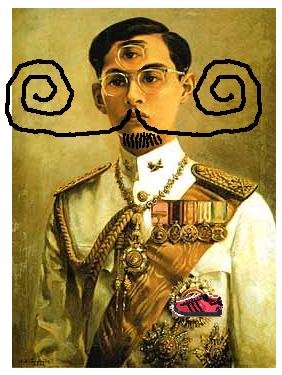
This Swiss gentleman got a bit betronken and used real spray paint on a real poster in Thailand.

I love this crime!
Lèse majesté! (See Wikipedia wiki below.) Whenever I wonder why we Colonials bothered to throw that tea into Boston harbor and overthrow our King, I'll re-read this story.

In honor of Herr Jufer's release from prison, and the King of Thailand's kindness and mercy, Vleeptron makes a toast:

Hey King Bhumibol Adulyadej!
Bite Me! You suck!
Your Junta sucks too!

==============

The Associated Press (wire USA)
Thursday 12 April 2007

Thailand's kind king
pardons, deports Swiss man
for defacing image of
Thailand's kind king


BANGKOK, Thailand (AP) -- The Thai king has pardoned a Swiss man who was given a 10-year sentence for spray-painting over images of the revered monarch, but the longtime Thailand resident has been ordered to leave the country, police said Thursday.

Oliver Rudolf Jufer, who last month became the first foreigner convicted in at least a decade under strict Thai laws protecting the monarchy, was expected to be deported back to Switzerland later in the day, said police Col. Sangob Sanudon, the chief of Chiang Mai's immigration office.

Police and prison officials in the northern city of Chiang Mai confirmed Jufer had been transferred Wednesday to a police station in Chiang Mai ahead of his deportation. They said he was expected to fly to Bangkok and then onto Switzerland.

"The king in his kindness has granted him a pardon and he has been transferred from prison and is in the process of being deported from the country," Chiang Mai police Col. Prachuab Wongsuk told The Associated Press.

A spokesman for the Swiss Embassy could not be immediately reached for comment.

Jufer was caught by surveillance cameras on December 5 spray-painting black paint over five outdoor posters of King Bhumibol Adulyadej in Chiang Mai, where he lived.

Bhumibol, who is greatly loved by Thais and regarded by some as semi-divine, is protected from reproach by strict laws that forbid any criticism of the monarchy.

Jufer, who lived in Thailand for 10 years, pleaded guilty in March to five counts of
lèse majesté, or insulting the monarchy. He had faced a maximum of 75 years in prison.

According to court testimony, Jufer had been out drinking with a friend and drove his motorcycle home to pick up a can of spray-paint, which he had bought to paint his dog house. He drove up to a municipal office where a large poster of the king was hung outside, and climbed a ladder to spray paint over the image. He then defaced four other posters near his home, according to the testimony.

The vandalism coincided with Bhumibol's 79th birthday, which was celebrated across Thailand with fireworks and prayers.

Millions of portraits of the king, who is the world's longest serving monarch, were hung late last year around the country to honor his birthday. Many Thais wear bright yellow shirts every Monday, the color that in Buddhist tradition represents the day of the week on which Bhumibol was born.

His case cast a rare spotlight on Thailand's strict lese majeste laws, which have remained virtually unchanged since the creation of the country's first criminal code in 1908, despite the overthrow of an absolute monarchy in 1932.

- 30 -

Copyright 2007 The Associated Press. All rights reserved.

===============

Your continued donations keep Wikipedia running!

Lèse majesté

From Wikipedia, the free encyclopedia

This article or section does not adequately cite its references or sources.
Please help improve this article by adding citations to reliable sources. (help, get involved!)
Any material not supported by sources may be challenged and removed at any time. This article has been tagged since December 2006.
This article or section is not written in the formal tone expected of an encyclopedia article.
Please improve it or discuss changes on the talk page. See Wikipedia's guide to writing better articles for suggestions.

Lèse majesté (French expression, from the Latin Laesa maiestas or Laesae maiestatis (crimen), (crime of) injury to the Majesty; in English, also lese majesty or leze majesty) is the crime of violating majesty, an offense against the dignity of a reigning sovereign or against a state.

This behaviour was first classified as a criminal offense against the dignity of the Roman republic in Ancient Rome. In time, as the Emperor became identified with the Roman state (the empire never formally became a monarchy), it was essentially applied to offenses against his person.[1] Though legally the princeps civitatis (his official title, roughly 'first citizen') could never become a sovereign, as the republic was never abolished, emperors were to be deified as divus, first posthumously but ultimately while reigning, and thus enjoyed the legal protection provided for the divinities of the pagan state cult; by the time it was exchanged for Christianity, the monarchical tradition in all but name was well established (an example of the way the Roman religion was made to serve the political elite).

In the (mainly Christian) states emerging after the fall of Rome the style of Majesty and the notion of offenses against it were exclusively related to offenses against the crown. In feudal Europe, various real crimes were classified as lèse majesté even though not intentionally directed against the crown, such as counterfeiting because coins bear the monarch's effigy and/or coat of arms.

However, since the disappearance of absolute monarchy, this is viewed as less of a crime, although similar, more malicious acts, could be considered treason. By analogy, as modern times saw republics emerging as great powers, a similar crime may be constituted, though not under this name, by any offense against the highest representatives of any state ( e.g. all heads of state, regardless of their title, as in Belgium).

Current lèse majesté laws

Few countries still prosecute lèse majesté. One exception is Thailand, where social activists like Sulak Sivaraksa were charged with the crime in the 1980s and '90s because they allegedly criticized the King[2]although the King in his 2005 birthday speech said he would not take lèse majesté charges seriously any more. Several high-profile cases were dropped. In September 2006, the leaders of a military coup accused prime minister Thaksin Shinawatra of lèse majesté; the Thai military is thought to be highly loyal to the king.[3] Although the King is held in great respect by many Thais, he is also protected by lèse majesté laws which allow critics to be jailed for three to 15 years. Politician Veera Musikapong was jailed and banned from politics for lèse majesté, despite the palace's opinion that the remarks were harmless. Frenchman Lech Tomacz Kisielwicz who in 1995 committed lèse majesté by making a derogatory remark about a Thai princess while on board a Thai Airways flight in international airspace was taken into custody upon landing in Bangkok and charged with offending the monarchy. He was detained for two weeks, released on bail, and acquitted after writing a letter of apology to King Bhumibol Adulyadej. Deposed Premier Thaksin Shinawatra and his political opponent Sondhi Limthongkul both filed charges of lèse majesté against each other during the 2005-2006 political crisis. Thaksin's alleged lèse majesté was one of the stated reasons for the Thai military's 2006 coup.[4][5][6][7] In March 2007 Swiss national Oliver Jufer was convicted of lèse majesté and sentenced to 10 years for spray-painting on several portraits of the king while drunk in Chiang Mai, Thailand[8]; however Mr Jufer was pardoned by the King on 12 April 2007[9].

Brunei is another country which will still prosecutes lèse majesté.

In the United States and most western democracies, except for Poland, the right of free speech protects verbal attacks on public officials, as long as they are not accompanied by threats of violence.

See also: Freedom of speech#Poland

Sondhi may face arrest over lèse majesté allegations

In Poland, it is illegal to publicly insult foreign heads of state present on Polish territory. On 5 January 2005, Jerzy Urban was sentenced to a fine of 20,000 z?oty (about 5000 euros) for having insulted Pope John Paul II, a visiting head of state.[10] During January 26-January 27, 2005, about 30 human rights activists were temporarily detained by the police, allegedly for insulting Vladimir Putin, a visiting head of state. The activists were released after about 30 hours and only one was actually charged with insulting a foreign head of state.[11]

References

1. ^ "Lese majesty", TheFreeDictionary.com, Columbia Encyclopedia, retrieved 22 September 2006.
2. ^ "A Critic May Now Look at a King", Macan-Markar, Marwaan, The Asian Eye, 18 May 2005.
3. ^ "Thailand's Ousted Prime Minister Is No Longer Democratizer", TNR Online, 20 January 2006.
4. ^ Asiaweek, A Protective Law, 3 December 1999 vol.45 no.28
5. ^ Colum Murphy, "A Tug of War for Thailand’s Soul", Far Eastern Economic Review, September 2006
6. ^ AFP, Thai coup leader says new PM within two weeks, 19 September 2006
7. ^ Time, World Notes Thailand: Not Fit for a King, 15 September 1986
8. ^ BBC News, Sensitive heads of state, 29 March 2007
9. ^ BBC News, Thailand's king pardons Swiss man, 12 April 2007
10. ^ "Criminal Defamation Laws Hamper Free Expression", IFEX.org, retrieved 22 September 2006.
11. ^ "28 Detained for insulting Putin?", Independent Media Center, 27 January 2005.

Swiss man jailed for Thai insult BBC News article


Is this the face that launched a thousand ships, and received a compensation package worth U$193,590 ?

Shaha Riza, external affairs manager, MENA,
World Bank, at Middle East and North Africa
Region Press Conference on 11 April 2003.
These photographs are in the public domain.
They are free to use for publication purposes.

Check one:

[ ] Much hotter than Monica Lewinsky

[ ] Yawn

If a War Crimes Tribunal ever rounds up the Top Six frothing psychos from the Bush administration who cooked up the Iraq War, Paul Wolfowitz will get a seat in the van. Wolfowitz was Deputy Secretary of Defense from 2001-2005, serving under Donald Rumsfeld. For his reward, Bush successfully pushed to make him the president of the World Bank.

Look ... what's the point of being one of the most powerful guys on Planet Earth if you can't pick up the phone and get your sweetie-pie a huge promotion? (By one account, Riza earns more than Secretary of State Condoleezza Rice.)

Wolfowitz and Sara, the mother of his two daughters and one son, divorced in 2002, so Wolfowitz is free to date and make out at embassy parties.

Is the g/f of the president of the World Bank supposed to drive herself around in a P.T. Cruiser? Get real.


============

The Associated Press
(pickup in Washington Post, DC USA)
Thursday 12 April 2007


Wolfowitz Sorry
for Hiring 'Mistake'


by Jeanine Aversa

WASHINGTON -- World Bank President Paul Wolfowitz acknowledged Thursday that he erred in helping a close female friend get transferred to a high-paying job. "I made a mistake for which I am sorry," he said.

The growing controversy has overshadowed major development meetings this weekend and is raising fresh questions about whether Wolfowitz will stay on the job.

At issue is the generous compensation of a bank employee, Shaha Riza, who has dated Wolfowitz. She was given an assignment at the State Department in September 2005, shortly after he became bank president.

"In hindsight I wish I had trusted my original instincts and kept myself out of the negotiations," Wolfowitz said.

He said he met Thursday morning with the World Bank's board and that members were looking into the matter. He declined to discuss what actions, if any, the board could take.

"I proposed to the board that they establish some mechanism to judge whether the agreement reached was a reasonable outcome," he said, referring to Riza's transfer. "I will accept any remedies they propose."

Wolfowitz dodged a question about whether he would resign over the flap.

"I take full responsibility for the details. I did not attempt to hide my actions nor make anyone else responsible," he said.

A World Bank spokeswoman would not comment on what range of options the board could consider and did not know when the board would finish its deliberations on the matter.

The Government Accountability Project, a watchdog group, estimated Riza's salary at U$193,590 as a result of the job transfer and pay raises. The group says she was paid by the World Bank and remains on the bank's payroll. The situation has brought accusations of favoritism from the bank's staff association.

Riza had worked as a communications adviser in the bank's Middle East Department before she took the assignment outside the bank. Rules bar employees from supervising anyone with whom they had a personal relationship.

The State Department says she left in September 2006 and now works for Foundation for the Future, an international organization that gets some money from the department.

The World Bank would not comment on Riza's compensation, citing confidentiality concerns.

- 30 -

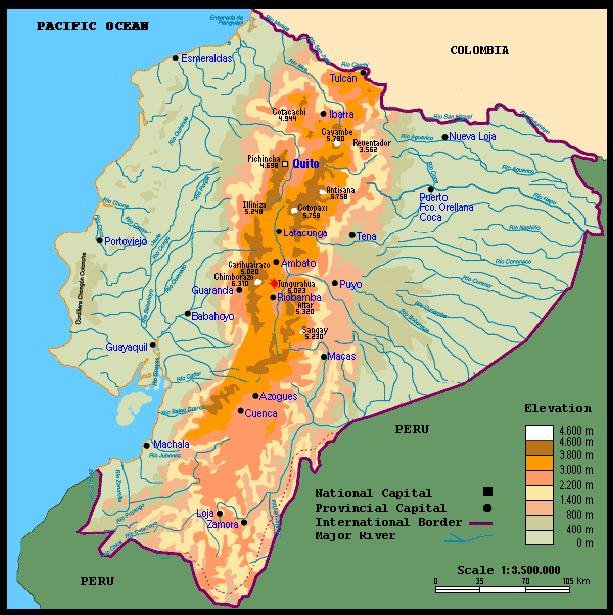
Tungurahua -- right now, Planet Earth's most violent volcano


Click around on all the images,
but particularly on the high-resolution
satellite photo of Tungurahua.

Here are some images of and associated with Planet Earth's most violent volcano at the moment,
Tungurahua, in the Andes in Ecuador. The red dot shows Tungurahua on the Ecuador map.

Just to put things in perspective, human beings are totally powerless and ineffective against volcanos. We could drop hydrogen bombs down a volcano's throat and the volcano would give no evidence of having noticed. We're not even very good at predicting their behavior in the short-term future.

The one thing we are getting better at is quantitative, empirical observation of volcanic and seismic activity, which we can use to do the only thing we can do which has positive, life-saving benefit: Warn people when to flee.

The volcano chooses its century or millennium to sleep. Then it chooses its own moment to wake up, often with less than a day's warning. Sometimes the people fleeing for their lives, who had lived near the volcano all their lives, didn't even suspect the mountain was a volcano. Vulcanologists probably aren't very confident about describing a volcano as either dormant, extinct or inactive. Only the volcano really knows if it's dormant, extinct or inactive. Maybe it was extinct. But then it changed its mind.

An immediate consequence of volcanic activity is the disruption, over a huge area of the planet's surface, of all air travel. Not only does the volcanic ash seriously degrade aviation visibility, but jet engines can encounter a sudden cloud of ash -- rock powder -- and shut down in flight. On Montserrat, the Soufriere volcano delivered the added insult of destroying the island's only airport, though a new airport, hastily built on the safe northern part of the island, has re-opened. The economic impact of an awakening volcano can be catastrophic and long-lasting. With only guesswork about the future to guide them, governments, insurers and financial institutions are exremely reluctant to pump money into a place that was just destroyed by a volcano and associated earthquakes.

Ironically, though the ash can destroy and disrupt agriculture for several years, the ash and lava spewing from a volcano are the raw material of incredibly rich, fertile new soil. The volcano destroys life and at the same instant the volcano creates life.

These are just ordinary, garden-variety deadly volcanos. Don't ask me about the Yellowstone Caldera, or Cumbre Vieja. You don't want to know about that. Don't even bother packing a bag. Think of Mother.

=============

IG [Instituto Geofísico-Escuela Politécnica Nacional] reported that during 21-27 March [2007], constant emissions of ash and steam from Tungurahua produced plumes that rose to altitudes of 7-10 km (23,000-32,800 ft) a.s.l. and drifted mainly W, NW, and N. Ashfall was reported from areas downwind and from areas SW within 8 km, on all days except 25 and 27 March. Noises resembling "cannon shots" and blocks rolling down the flanks were heard on 21, 22, and 25 March; windows rattled as far away as 11 km N in Guadalupe. On 23 March, lahars traveled mainly down NW gorges and affected the roads between Ambato and
Baños, and between Baños and Penipe.

Sources: Instituto Geofísico-Escuela Politécnica Nacional - "Report provided courtesy of the Smithsonian's Global Volcanism Program and the US Geological Survey's Volcano Hazards Program."

==================

Tungurahua is an active stratovolcano also known as the "The Black Giant." It is a steep-sided andesitic-dacitic stratovolcano that towers more than 3 km above its northern base, is one of Ecuador's most active volcanoes. Three major volcanic edifices have been sequentially constructed since the mid-Pleistocene over a basement of metamorphic rocks. Tungurahua II was built within the past 14,000 years following the collapse of the initial edifice. Tungurahua II itself collapsed about 3000 years ago and produced a large debris-avalanche deposit and a horseshoe-shaped caldera open to the west, inside which the modern glacier-capped stratovolcano (Tungurahua III) was constructed. Historical eruptions have all originated from the 600 ft. (183 m) wide summit crater. They have been accompanied by strong explosions and sometimes by pyroclastic flows and lava flows that reached populated areas at the volcano's base.

Tungurahua causes many tremors in the nearby city of
Baños. Tungurahua's lava is mostly composed of basalts. Tungurahua has had at least seventeen eruptions in historical times Prior to a long-term eruption beginning in 1995 that caused the temporary evacuation of the city of Baños at the foot of the volcano, the last major eruption had occurred from 1916 to 1918, although minor activity continued until 1925.

==================
about the image from space:
==================

Tungurahua Volcano
in Ecuador


Image Acquired: 16 October 2006

The Tungurahua Volcano in Ecuador underwent a severe eruption in August 2006, followed by intermittent eruptive activity over the next couple months. On October 16, 2006, the Advanced Spaceborne Thermal Emission and Reflection Radiometer (ASTER) on NASA’s Terra satellite captured this image of the volcano as it released a plume of volcanic ash.

This false-color image was created by combining shortwave infrared, near-infrared, and green wavelengths of light observed by ASTER. The image clearly shows not only current volcanic activity, but also the results of earlier eruptions. Deep purple rivulets of rock carve through the bright green vegetation. The rock results from previous lava flows that later solidified. Similar in color to the hardened lava are geometric patches of bare ground on the volcano’s slopes, some of the numerous settlements in the area.

The Chambo River makes a bright blue ribbon along the western edge of the volcano. Pyroclastic flows of rocks, ash, and other volcanic materials temporarily dammed the Chambo River in August 2006, and the purple remains of earlier eruptions cross this river in the west and the north. At the volcano’s summit is a glowing red dot, indicating an area of intense heat. The ash cloud in this image appears bright purple, in contrast with the white clouds to the northwest.

Image courtesy of Nick Smith and Matt Patrick, Michigan Tech University; and Patricia Mothes, Instituto Geofísico, Escuela Politécnica Nacional.

================

Monitoring Volcanic Eruptions
with a Wireless Sensor Network


Geoffrey Werner-Allen, Matt Welsh
Harvard University

Jeff Johnson
University of New Hampshire

Mario Ruiz
UNC and Instituto Geofísico, EPN

Jonathan Lees
UNC

Paper accepted to EWSN '05. This is the camera-ready version.

We deployed a wireless sensor network to monitor eruptions at Volcán Tungurahua, an active volcano in central Ecuador. This network consisted of five tiny, low-power wireless sensor nodes, three equipped with a specially-constructed microphone to monitor infrasonic (low-frequency acoustic) signals emanating from the volcanic vent during eruptions. We gathered over 54 hours of continuous infrasound data, transmitting signals over a 9 km wireless link back to a base station at the volcano observatory.

Composed of small, low-power wireless devices, sensor networks constitute a new kind of computing platform. A typical wireless sensor network platform, or "mote", integrates a computationally-limited processor and limited storage capacity with an flexible interface allowing various sensors to be attached. The energy, memory, computation, and bandwidth limitations of sensor network devices pose system design questions that require continued research if robust deployments are desired.

To date, habitat, medical, and structural monitoring applications have been deployed on sensor networks. To our knowledge this is the first dense wireless array deployed for volcanic monitoring.

Background

Volcanologists collect seismic and infrasonic signals to monitor and study volcanic activity. Volcanos emit powerful seismic waves while erupting; but tectonic earthquakes, mining operations, and ambulating quadripeds can also induce seismic energy, complicating eruption detection based on seismic events alone. Because volcanos also emit powerful pulses of infrasonic energy near the moment of eruption, in cases where visual monitoring is impossible, inconvenient, or dangerous, correllating infrasonic and seismic events provides better eruption detection than either taken alone. Additionally infrasonic signals provide additional informational content not found in the seismic data.

Wireless sensor networks consist of small, low-power devices equipped with a radio, a variety of sensors, and a modest amount of computational power and local storage. A typical sensor "mote" is powered by 2 AA batteries and includes an 8-bit microcontroller, 4 KB of memory, a low-power radio with a range of approximately 100 meters and a bitrate of about 38 Kbit/sec. The low cost, size, and energy requirements of sensor networks makes them very attractive for volcanic monitoring. Our small array of infrasonic sensors monitored volcanic eruptions, reporting real-time data over a wireless link to a base station. A larger infrasonic array consisting of dozens of motes could be used to eliminate sources of noise as well as to triangulate the source of an eruption event.

Volcán Tungurahua

Tungurahua (map) is an active volcano in central Ecuador, near the town of Baños. The Instituto Geofísico of the Escuela Politecnica Nacional (IG-EPN) in Quito maintains an observatory near the volcano that is responsible for monitoring eruptions and apprising the government and media of changes in eruptive activity. Dormant for over 80 years, in 1999 Tungurahua began showing increased seismic activity which led researchers to believe that the volcano was awakening. Baños was evacuated by the Ecuadorian military in anticipation of a large event, which did not in fact occur. After several months the populace of Baños was allowed to return to their homes. Since then the volcano has been experiencing a period of increased eruptive activity, making it an ideal candidate for volcanic research.

This collaboration between researchers at Harvard, UNH, IGEPN, and UNC resulted in the deployment of a wireless infrasonic sensor network at Volcán Tungurahua from July 19-23, 2004. During this time, the volcano was erupting at the rate of several small or moderate explosions an hour, though the rate and energy of eruptions varied considerably. Our sensor network recorded over 54 hours of data from three wireless infrasonic microphone nodes, relaying the data back to the observatory over a 9 km radio link. A laptop at the observatory recorded the complete data traces and visualized the signals in real time. The wireless sensor array was colocated with a wired monitoring station recording infrasound and seismic signals, allowing us to verify our signals against an trusted monitoring platform.

Equipment

Five Mica2 sensor network devices performing three different tasks composed our volcano monitoring network: three data-collection motes fitted with custom-built infrasonic sensors, one receiver mote forwarding data over a long-range serial point-to-point link, and one time synchronization mote interfaced to a GPS unit providing a common time base for the data collection elements.

The three data-collection motes integrated the Mica2 with an infrasonic microphone (Panasonic BM-034Y) and custom amplification and filtering circuitry. Sampling at approximately 102 Hz, they transmitted data packets containing multiple readings to the receiver mote at approximately 4Hz. A Mica2 receiver mote attached to a MIB600 interface board forwarded data packets along a long-range serial point-to-point link, provided by a pair of FreeWave modems fitted with 9dBI directional Yagi antennas, back to the observatory 9 km away. A laptop connected to the FreeWave modem at the observatory logged the data and provided real-time monitoring capabilities.

To provide the required common time base for the data-collection motes, an additional Mica2 mote was interfaced with a off-the-shelf Garmin GPS receiver. The time synchronization mote receives a time pulse every second from the GPS unit and relays the pulse to the infrasound motes via radio. Each mote marks the infrasound sample taken when each GPS timepulse is received, allowing the signals from each mote to be synchronized across time.

Equipment pictures:

The sensor node software was implemented in TinyOS, a tiny operating system for sensor networks. Laptop software was implemented in Perl and Java running on the Linux operating system.

Through the deployment the Freewave Modems and GPS receiver were powered by standard 12 Volt car batteries, a readily available energy source in Ecuador. All other devices were powered by 2 AA batteries. No power sources required replacement over the duration of the deployment.

Data Collection and Analysis

Our wireless sensor network stored 54 continuous hours of infrasonic data into approximately 1.7 GBytes of uncompressed log files. During that time several sets of eruptive pulses were recorded. We are continuing to analyze the data we recorded, comparing it against signals recorded by several different wired monitoring stations. Displayed below are one set of traces from our wireless sensor network compared to two different wired stations: one co-located with our deployment and the other at a different site on the volcano. Note that the wired Larson-Davis microphone signals shown have inverted polarity.

10 April 2007

3292 US soldiers & marines killed in Iraq to 9 April 2007

it's deja vu all over again

Click once or twice.
Stop the war immediately.


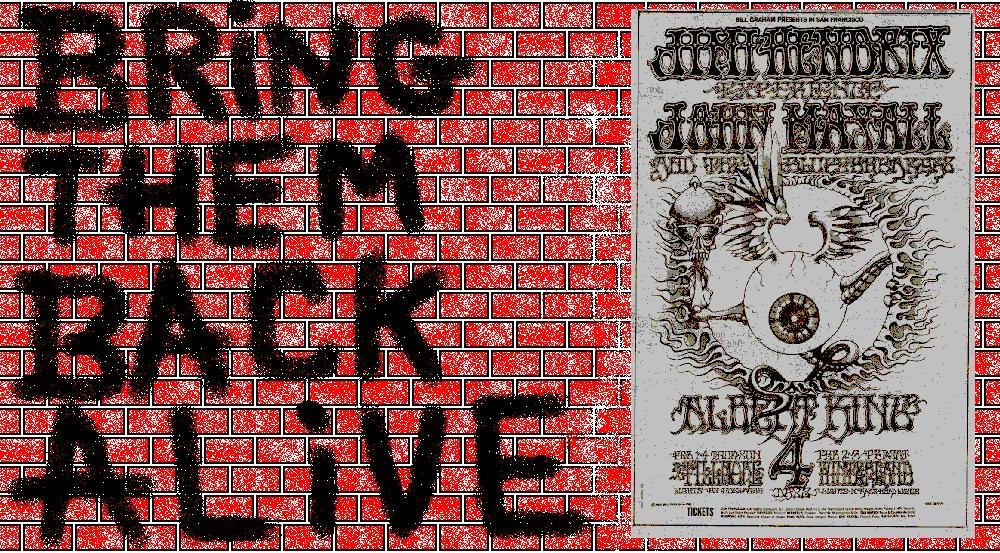
Poster of February 1968 Winterland & Filmore concert in San Francisco with the Jimi Hendrix Experience, John Mayall & the Bluesbreakers, and Albert King. Artist: Rick Griffin.


When this song, by the disco star Freda Payne, was released in the midst of the Vietnam War and became a hit on U.S. radio stations, Armed Forces Radio Network banned it and wouldn't broadcast it.

You expect folksingers to sing anti-war songs, not disco singers. And you don't expect Country & Western singers to make anti-war noise, either.

When the war's sucky enough, Polka Bands start singing anti-war songs.

Remember any good pro-war songs from Vietnam? Anyone been singing any good pro-war songs about Iraq? Leave a Comment.

It took 5 or 6 minutes to spray-paint the text. Try not to get caught. If you get caught, plead Not Guilty and demand a jury trial. Make as much media noise as you can. Grafitti all over town, grafitti all over C-Space, grafitti text messages, grafitti on cell phones and iPods.

Make the prosecutor look like a psycho right-wing war freakazoid. If there've been shootings and rapes and armed robberies in town, ask the TV news why the prosecutor is wasting time on you. Call up the radio shows late at night, talk about the war. College radio stations are best.

~ ~ ~

BRING THE BOYS HOME

1971

sung by Freda Payne
composer: General Johnson


Fathers are pleading,
lovers are all alone

Mothers are praying --
send our sons back home


You marched them away -- yes, you did --
on ships and planes

To the senseless war,
facing death in vain


Bring the boys home
(bring 'em back alive)

Bring the boys home
(bring 'em back alive)

Bring the boys home
(bring 'em back alive)

Bring the boys home
(bring 'em back alive)


Turn the ships around,
lay your weapons down


Can't you see 'em marchin' 'cross the sky,
All the soldiers that have died

Tryin' to get home --
can't you see them tryin' to get home?

Tryin' to get home --
they're tryin' to get home


Seesaw fire on the battlefield
Enough men have already been wounded or killed

Bring the boys home
(bring 'em back alive)

Bring the boys home
(bring 'em back alive)

Bring the boys home
(bring 'em back alive)

Bring the boys home
(bring 'em back alive)


why don't you
Turn the ships around,
lay your weapons down


Mothers, fathers and lovers,
can't you see them?

Oooh, oooh ...
Tryin' to get home --
can't you see them
tryin' to get home?

Oooh, oooh ...
Tryin' to get home --
they're tryin' to get home


Bring the boys home
(bring 'em back alive)

Bring the boys home
(bring 'em back alive)

Bring the boys home
(bring 'em back alive)

Bring the boys home
(bring 'em back alive)


What they doing over there, now

(bring 'em back alive)

When we need them over here, now

(bring 'em back alive)

What they doing over there, now

(bring 'em back alive)

When we need them over here, now

(bring 'em back alive)


09 April 2007

Anonymous Driveby Hero says: Iraq War is GREAT! Now let's invade SYRIA!

Cell-phone image of
Sadaam Hussein's hanging

Hip Hip Hooray.
2 Cheers for Regime Change.
Everybody's so much freer now.
America's so much safer.

The original post on Old Vleeptron that this belated Anonymous Driveby Comment is complaining about:


It's worth re-reading or reading for your first time. I was very proud of that post. It's about a piece of American war history that's so old nobody remembers it. But read it and see why, in the midst of the Iraq War, everybody SHOULD know about it.

Here's yesterday's Anonymous Driveby Comment:

==================

[News, Weather, Mozart, Sports, Eurovision Love Aenema & Perverted Videogames from Vleeptron] 4/08/2007 09:24:16 PM

1 Comments:

Anonymous said...

You know- war is a terrible thing, but your sweeping condimnation of what we have done in Iraq is ill-informed an inaccurate. I was there for 18 months and did the following:

1. set oppressed people free
2. helped capture Sadam Hussein

we shouldn't stop there, maybe Syria should be next. I hate to see people suffer.

/s/

ARMY MAN
21:24

==============

HEY ARMY MAN!

You're a Day Late and a Dollar Short. You're replying to a post that's so old that the old Vleeptron blog is now extinct.

And you also broke Vleeptron's Only Rule: You commented Anonymously, with no link or e-mail addie. You're an Anonymous Driveby Comment.

Check out these Vleeptron blogs. They're signed. They have my name and address on them.

I may say True Things, or False Things, or Good Things, or Evil Things. But everybody in C-space knows who said them.

Nobody knows who said what you said. Nobody can know who you are.

You could be a Political Troll-for-Hire, paid to leave pro-war Comments on anti-war sites. On the War in Iraq, on No Child Left Behind, on the War on Drugs, the Bush administration has a real smarmy history of injecting paid partisan opinions into the public dialogue, masquerading as independent citizen voices.

So far, my Big Vleeptron Mouth hasn't earned me a dime from anybody.

Let's pretend -- with utterly no evidence, thanks to your choice to comment as Anonymous -- that you are what you said you are, an Iraq War Army vet.

Thanks for serving, if you served. I have no way of knowing.

I served, too. US Army 1969-1971. (You're welcome.) I think you can check my name out with the US Army records center in St. Louis. They'll tell you if I served.

And that's the difference between you and me. This swell wonderful patriotic Iraq War is your first senseless, misbegotten, fucked-up, foot-shooting, never-ending American war.

It's my second senseless, misbegotten, fucked-up, liars' scoundrels' foot-shooting American war. Check out the Memorial to my war in my hometown, Washington DC. Get there at dawn. How long will it take you to read the 58,249 names of U.S. servicemen and servicewomen who died in the Vietnam War?

At one second per name, without a pause, plan to be there for 16.2 hours. Arrive at 06:00, start reading, you'll get to the end around 22:15 .

Your Foxic Talking Points:

1. set oppressed people free

In 1945, guys who wore our uniform liberated concentration camps in Europe and set oppressed people free. This moment wasn't followed by five years of genocidal civil war. After the surrenders, the people of Germany and the people of Japan laid down their arms and immediately stopped killing American soldiers.

The Bloomberg School of Public Health study says that since the U.S.-led invasion of Iraq, 160,000+ Iraqi civilians have died of violence who wouldn't have died if the invasion hadn't happened.

Setting oppressed people free to die and to kill one another by the hundreds of thousands with no end in sight isn't the flag-waving patriotic heart-sweller you're trying to paint it. If the US-led coalition can claim Victory and Mission Accomplished -- why are so many soldiers and marines still coming back to Dover Air Force Base in coffins at the Victory+5 year mark?

2. helped capture Sadam Hussein

So what?

At the time, there were easily 40 equally brutal totalitarian police-state dictatorships that the USA either worked with as our allies, or did routine business with, but didn't declare Regime Change War against. Our "Friendly Dictators" is the way the USA routinely does business.

Sadaam Hussein in particular was the USA's pet mad dog during the 10-year Iraq-Iran War, he was our proxy, he had our support and our help, and we turned a blind eye when he developed and used chemical weapons against Iranian troops. We hated Iran so much for the humiliation of the hostage crisis that we adopted the Arab bumper sticker: "The enemy of my enemy is my friend."

So we captured him and our new puppet government hanged him in a clear act of sectarian Shia revenge.

If I could only see as far as my own country, what good things has that done for America?

But I can see farther. What's that done for Iraq? What's that done for the region?

I'm afraid to click on the website of the United Nations High Commissioner for Refugees to see the actual numbers. We've destabilized the entire region and flooded it with hundreds of thousands of refugees pouring across the borders into Jordan, Iran, Syria. The region will be reeling with the unhealthy and violent anti-American consequences of this war for decades -- just as Southeast Asia is finally barely recovering from the consequences of the Vietnam War.

And now we're dicking around with a new war against Iran.

Your personal pick is a war with Syria.

The Democratic Speaker of the House Nancy Pelosi just went to explore diplomatic chat with Syria.

You want to invade, kill towelheads -- or do you prefer "sand niggers"? -- and send a new crop of American body bags back to Dover Air Force Base, and a new crop of amputees and PTSD vets back to Walter Reed and the VA hospitals.

How's that War vs. Diplomacy option been working out in Iraq?

On Fox News, Shock and Awe against non-Christian Asians who don't kiss America's ass sounds really delicious, all cute cheerleaders and kissing the boys as they march off to war.

I served so I could keep my big loud American mouth, and my opinions about America's fucked-up liars' kill-our-kids wars.

And you volunteered so you could be Anonymous? Am I supposed to wave some sort of flag at that?

P.S. Fox News is always reminding us that Iraq isn't Vietnam because only


(to 8 April 2007) US troops have died in Iraq so far -- chump change, a bargain for such a swell war.

But as Bush's War Without End keeps on chugging -- already dragging on longer than it took to achieve victory in Europe and Japan during World War Two -- I think this is a good time to start designing the Iraq/Afghanistan War Memorial for the Washington DC Mall.

All war psychos like you have given us so far is dead soldiers, the dead and maimed children of my neighbors. So take a stab at your design for the inevitable Memorial to this great war.

cops v citizens

08 April 2007

Falun Gong's huge 1999 anti-Party protest in Beijing

Clicking probably helps.

Repressive, violent regimes don't always manage to suppress all anti-government protest activity and opposition. China is having a particularly difficult time figuring out how to manage or handle the popular religious movement known as Falun Gong or Falun Dafa. Above, Falun Gong members make the movement's emblem at a rally in Wuhan, Peoples Republic of China. Meanwhile, Falun Gong has become established in nations outside China. The above image is from a Falun Gong/Falun Dafa website hosted at the University of Michigan, in Ann Arbor, Michigan USA.

* * *
The New York Times (USA)
26 April 1999


10,000 Protesters in Beijing
Urge Cult's Recognition


by SETH FAISON

BEIJING -- More than 10,000 followers of a religious cult surrounded China's leadership compound Sunday, demanding recognition from authorities who are wary of any group not easy controlled. It was the biggest protest here since the democracy movement in Tiananmen Square in 1989.

Coming as a complete surprise to the authorities, the protest drew followers from all over China. Eerily silent and devoid of banners or slogans, the protesters seemed to materialize out of nowhere, suddenly appearing in large numbers at the seat of Chinese power in the middle of the morning and remaining immovable all day long.

Displaying remarkably good organization and discipline, with demonstrators remaining motionless and calm and seated on the sidewalk while organizers communicated by mobile telephones. Many protesters apparently tried to use meditation to persuade leaders to see them in a more favorable light.

The cult, known as Buddhist Law, asserts that it has more than 100 million members in this country of 1.2 billion, the largest among hundreds of cults that have flourished in China in recent years as socialism evaporates as an ideology. Preaching good behavior to win salvation from an increasingly evil world that is headed for catastrophe, followers believe that they can cure illness and eviscerate wickedness from the world.

The cult's popular leader, Li Hongzhi, 48, moved to New York City two years ago, under pressure from the authorities to restrict his activity.

Dressed in simple clothing, followers converged from many provinces of China, sitting all day on worn squares of cotton padding in long rows that stretched for nearly two miles along two sides of Zhongnanhai, the compound in central Beijing where China's leaders live and work.

The police, apparently eager to avoid a confrontation, did not force the protesters to move, and the gathering dispersed peacefully by 10 p.m.

The protest came right in the middle of a most politically sensitive time, the 10th anniversary of the student movement that began in April, 1989, and just weeks before the anniversary of the crackdown in Tiananmen Square on June 4. China's leadership is already deeply concerned about the potential for social unrest as a wrenching transition to a market economy is throwing tens of millions out of work.

As China becomes a less regimented society -- with people confused over conflicting laws and regulations and with tens of millions of people losing their jobs as state-run industries close -- religious cults with mass followings like this one appear to pose a greater threat to social order than democracy advocates do.

"The authorities can surgically take out political activist groups, but this is a whole new thing, far harder to control," said Robin Munro, a China scholar who researched Chinese political opposition groups for years as head of Asiawatch in Hong Kong. "Sects are inherently peaceful, but only become politicized, and then potentially explosive, when repressed."

Mindful of the strong role that secret societies played in the downfall of the last imperial dynasty, in 1911, China's leaders are juggling their need for social order with popular demands for greater religious freedom.

To many Chinese bewildered by a fast-changing society, perhaps the greatest appeal of a cult like Buddhist Law lies in its simplicity.

"What we stand for is good for the nation and good for society, so how can we threaten anyone?" said a 47-year-old woman in a worn green jacket who sat near the corner of Zhongnanhai. "They don't understand us. We want understanding."

Several other followers nodded in agreement as the woman spoke.

"We will stay as long as it takes," said a 52-year-old man in a tattered grey sweater. "A day, a week, a year. We are not in a hurry."

The protesters, wary of giving their names or talking in detail about their organization, said they were demanding a meeting with Prime Minister Zhu Rongji. In the late evening, as the protest dispersed, organizers announced to small groups that they had been promised a meeting with members of the State Council, China's Cabinet. The government made no announcement, and state-run news media were conspicuously silent about the protest.

Buddhist Law is a sect of qigong, a traditional Chinese teaching that incorporates a broad range of healing techniques, martial arts and meditation. The overwhelming majority of Chinese believe in some form of qigong, while some join cults built on the teachings of a particular master, like Li.

The Communist Party denounces cults as superstitious remnants of an earlier age and asserts that many charismatic qigong masters fool followers with get-rich-quick schemes and fake medicine.

Many of the cult followers carried a book by Li. Buddhist Law, founded by Li in 1992, preaches that evil lurks in the modern appearance of rock 'n' roll music, television, drugs and homosexuality. Although the group is vehemently opposed to modern science and technology, many members use the internet to spread the group's message.

"Your diseases will be eliminated directly by me," wrote Li in one of his five books, regarded by followers as sacred texts.

Li's teachings echo ancient Chinese civilization, asserting the power of healing by using qigong to tap into a person's "inner energy." The cult also uses the Buddhist notion of karma, which holds that people's good and bad deeds determine their fate in the next life.

The origin of Sunday's protest apparently lay in a recent article in an obscure academic journal published in the coastal city of Tianjin, that warned of the dangers posed by cults in China. Several protesters said they were deeply offended by the article and that a dozen followers were arrested in Tianjin last week after a small protest there.

Last year, after Beijing Television broadcast a program critical of Buddhist Law, organizers engineered a protest outside the television station. Two employees of the station were later said to have been dismissed because of inaccuracies in the broadcast.

Buddhist Law has apparently earned tens of millions of dollars by selling Li's books and videotapes of his preachings, as well as meditation cushions and pictures of Li. But the full size and scope of the operation remains hidden.

The organization, secretive about its operations, has a network of support in the United States, and the followers say that many Communist Party members, senior officials and police officers are among its members.

Li, who asserts that he has a higher spiritual authority than Jesus, Mohammed or Buddha, teaches that he was sent to earth by a "supreme being" to save mankind from moral corruption caused by consumerism, modern science and technology.

Chinese society has disintegrated so seriously, Li contends, that many humans are reincarnated as demons, some of them disguised as monks.

"Especially in Taiwan," he has written, "many famous monks or lay Buddhists are actually demons."

Competing for followers with other cults, Li has denounced other qigong masters as "possessed with foxes or yellow weasels, and some with snakes."

At Sunday's protest, followers extolled the virtues of their cult, talking more about the beneficial effects of moral discipline than about the greatness of their leader.

"I am a better father and husband and citizen," said a 48-year-old man from Hebei Province, who said he had been a member of Buddhist Law for six years. "We are making a better society.

"I don't get sick anymore," the man continued. "If everyone is healthy, it will save medical costs and be good for society as a whole."

Sunday's protest, populated mostly by people from outside the capital, elicited much fascination but limited sympathy from Beijing residents, thousands of whom gathered to look on.

"They're crazy," said Li Xiaoming, 27, who works for a transport company. "But there are a lot of them, so the government has to listen."

- 30 -

irc relapse

Click and Pray.

05 April 2007

the Disgusting Spectacle (coin-operated)

Click & Insert Coin.

One of Tim Hunkin's first automata, and the title of his first automata exhibition. "The Disgusting Spectacle" now resides at his Cabaret Mechanical Theatre in England.

Many artists are commercially successful, but Hunkin is one of the very few artists who have to drag their earnings around in big sacks of coins.

Thai junta bans YouTube for video seen as insulting to king


Still of Thailand's King Bhumibol Adulyadej, from paddidda's banned YouTube video.


Agence France-Presse
pickup in Sydney Morning Herald (Australia)
Thursday 5 April 2007


Thailand faces
criticism for
blocking YouTube


Thailand's decision to ban video-sharing website YouTube has highlighted a growing crackdown by the junta against political comment online, a media rights group said on Thursday.

The military-installed government announced Wednesday that it had banned YouTube after authorities failed to block a video considered insulting to King Bhumibol Adulyadej, a revered figure here.

The 44-second clip shows images of the king, crudely altered with a graphics programme, which flash on the screen to the tune of the Thai national anthem.

One image shows the monarch under a photograph of feet, which are considered the lowest part of the body in Buddhism. The image is hugely offensive in Thailand, a mainly Buddhist country.

The Southeast Asian Press Alliance said that while commentary about the king is culturally sensitive in Thailand, blocking the entire site raised serious concerns.

"Thais are now deprived of a popular and accessible medium that can accommodate alternative and independent voices," it said in a statement.

"There is a growing spectre of intolerance toward web-based media as a whole. The Internet is vulnerable in Thailand, and not just when it comes to material pertaining to the king," it said.

Since the military seized power in a September coup, it has also blocked political websites linked to ousted premier Thaksin Shinawatra as well as a university discussion board.

Police are also investigating a website calling on the king to sack his top adviser, Prem Tinsulanonda, over his alleged role in masterminding the coup.

YouTube is owned by Internet giant Google, and has a monthly audience of more than 70 million viewers. The company did not immediately respond to email queries for comment.

- 30 -

© 2007 Agence France-Presse

From the AFP website:
AFP is the world's oldest established news agency, founded in 1835 by Charles-Louis Havas, the father of global journalism.

04 April 2007

Tim Hunkin'sString & Drum Fax Machine

Click if you so desire.

I saw Tim Hunkin and his associate do this, and it worked. My guess is you can do this yourself for about $30. I think it would be a great Science Project for elementary school, junior high, high school, undergraduate university, graduate school, postgraduate studies, or for amateur self-amusement. Anyway, this is the principle on which the Fax Machine operates. It's been some time, but I'm pretty sure I got the essentials down right. It's the most amazing thing I ever saw on TV.

For more fun than people should be allowed to have with their trousers on, rent or buy and watch "The Secret Life of Machines." The theme song is a Ska cover of Dave Brubeck's jazz classic "Take 5," in 5/4 time.

My first encounter with Tim Hunkin's work was a cheesy tourist trap in Covent Garden called the Cabaret Mechanical Theatre. Well, call me a rube from the boondocks, but gawrsh I just gawked for hours, and dropped 10 Pounds of coins in the amazing little wooden machines to make them dance over and over again. My favorites were "The Last Dodo" and "Anubis in Montmartre." (The jackal-headed god Anubis, in a fancy Italian suit, stirring a demitasse of coffee at a little sidewalk cafe.)

As a kid Tim Hunkin got a summer job repairing the electromechanical coin-operated machines, like the Gypsy Fortune Teller, at an old-fashioned English seaside resort. As he learned their innermost secrets, he became very fond of these machines and wanted to explore their artistic possibilities by creating his own wooden coin-operated automata.

Why isn't it Sir Tim Hunkin by now?

whooooooooooooooooosh! wheeeeeeeeeeeeeeeee!

Cliquez bien sur

The French TGV (Tres Grande Vitesse) train V150, which has just broken the world speed record -- 357 miles per hour / 574.8 kilometers per hour -- for wheel-on-track trains. A slower version of the train will begin running this summer.

That's my comment (jameskpolka) down below. USA! We're Number 607!

19th-century trains featured a cowcatcher, a triangular guard in front of the engine to bounce cows off to the side of the track. Speed's picked up a bit and now they worry about smashing into a bird.

I did the Chunnel TGV once, from Bruxelles to London. They kept their promise of London by Lunch. But I don't think I'll be riding TGV very much in the future. Traditional trains for me, I think.

1. It rides in a deep ditch in the ground for noise abatement. You look out the window and all you see is the sides of the ditch.

2. Me and my backpack arrived at Bruxelles station with plenty of time to spare -- from my experience with European trains, the traditional 5 minutes. So I missed my train. The TGV has the same paranoid security as an airport, and you have to arrive at least 45 minutes before departure to be x-rayed and to provide documentary proof that you're not Muslim.

3. Nobody wants to chat or walk around and explore. It's so $$$ pricey that it's a snooty businessman's train and everybody has his face buried in The Economist.

These are minor gripes. I'm deeply grateful that SOMEBODY'S pushing the envelope for train travel. Big passenger airliners really suck, it's the most horrible way to get around the world anyone could imagine.

German maglev test track just had a bad, nasty accident, but it wasn't the technology, it was human screwup, somebody accidentally parked a maintenance truck on the trainpath.

I'm dying to ride the Shinkansen/Bullet Train. And I'd hop on the TGV again for a trip from Paris to Marseilles. Read below! The TGV has put some AIRLINES out of business!!! Yay!

~ ~ ~

Reuters / pickup on CNET
Tuesday 3 April 2007

France celebrates
train's new speed record
in Champagne

A French TGV train broke a world speed record on Tuesday as it hurtled down a newly built track at 357 miles per hour (574.8 kilometers per hour) in the country's Champagne region.

The special train called V150, an enhanced version of trains that will run on the Paris-Strasbourg line beginning June 10, has been preparing for the record run for weeks, and it carried journalists and other guests for the official attempt.

From about 236 mph, vibrations in the train became more and more noticeable. At 304 mph, passengers started to get slightly dizzy. At 335 mph, it became difficult to remain standing up despite the stability of the train.

At 354 mph, the driver wore a very big smile. "We had no worries--no birds, good weather, none of the troubles we had during the tests," said driver Eric Pieczak.

The absolute speed record for trains was set by a 'maglev' train in Japan, at 361 mph in 2003. However, those trains do not run on rails but glide on a magnetic field.

The previous speed record for a train running on rails was 320.2 mph, set in France in 1990.

Engineer Alstom, state railways group SNCF and track operator RFF had teamed up to show off French engineering and boost export prospects for French trains.

President Jacques Chirac and Prime Minister Dominique de Villepin both praised the new record.

"This record is a magnificent demonstration of France's great abilities in research and development and is further proof of the excellence of the French rail industry," Chirac said.

Philippe Mellier, the head of Alstom's transport division, said the commercial speed of Train a Grande Vitesse trains could reach 217-224 mph in the next five to six years. The latest TGVs run at 199 mph.

"An operator and a country that wants to launch high-speed rail, that is a lot of money at stake, they need to be able to do that in complete safety," he said.

Apart from France's TGV and Japan's Shinkansen, high-speed trains are also made by Germany's Siemens and Canada's Bombardier.

The V150 was made up of two normal cars that will run on the eastern TGV track, three double-decker carriages and three sets of motorized wheels. The train can develop over 25,000 horsepower, twice that of a conventional TGV.

The record was set at Le Chemin between Preny, near Metz in the east of France, and Bezannes near Reims at 1116 GMT.

The event run was broadcast live on television in France and Germany. The total record operation cost $40 million (30 million euros), shared by the three partners.

High-speed trains in France, as well as rail links to London, Brussels, Cologne and Amsterdam, are competing with plane travel, and several French regional airlines have gone out of business since the TGV started in 1981.

Story Copyright © 2007 Reuters Limited. All rights reserved.

3 comments

no so fast...
Reader post by: Tamagotchi Tamagotchi
Posted on: April 3, 2007, 1:08 PM PDT

The MAGLEV tested 3 years ago was not even close to reaching its top speed... and basically in its current configuration the sound barrier is it theoretical top speed.
Re: Not so fast...

Reader post by: chuck_whealton
Posted on: April 3, 2007, 3:25 PM PDT

Tamagotchi...

In the pictures of the V150 they briefly mention that the technology behind the MAGLEV is different in that it's electromagnetic with the train never touching the track.

It sounds like they're both great pieces of machinery. I know I'd enjoy taking a ride in either of them (preferably both!).

Charles R. Whealton
Charles Whealton @ pleasedontspam.com

Readerpost by: jameskpolka
Posted on: April 4, 2007, 10:02 AM EDT

Who needs fast trains? USA! We're slowest!

The United States is pioneering the future of trains and currently holds the Slow Speed Train world record -- AMTRAK Train 66 from Washington DC Union Station to New Haven Connecticut, a 9 hour trip from 9pm to 6am the next morning, set in 2005 -- a feat accomplished in mid-summer with neither air-conditioning, food service, nor functioning toilets. I was privileged to be a passenger aboard this record-breaking run.

Copyright ©2007 CNET Networks, Inc. All rights reserved.

03 April 2007

Zimbabwe -- Mugabe's last days? Or will he rule to his 100th birthday?

Children display a stadium image of President Robert Mugabe at the 25th anniversary of independence for Zimbabwe in 2006. (Daily Telegraph, UK)

No continent on Earth has Africa's dismal ratio of Bad News to No News -- of terrible things happening, but very few details about the terrible things reaching the Wealth and Information Centers and the news consumers of Europe and North America. The BBC must do its reporting about Zimbabwe from outside Zimbabwe; BBC news crews are banned by the Mugabe government.

Like Idi Amin of Uganda, Robert Mugabe seems outrageous, a total villain, out of control, a madman, and the West wonders how the black African governments that are Zimbabwe's neighbors can stay seemingly silent about degenerating conditions in Zimbabwe. In particular, South Africa has maintained largely a diplomatic silence about worsening internal conditions in Zimbabwe -- a silence that many in the West and some increasingly blunt African leaders are interpreting as consent for Mugabe's violent and anti-democratic actions. The West wonders why sub-Saharan governments do not take blunt action to destabilize and end the Mugabe regime.

But for black Africa to take meaningful action against Mugabe would mean that African politicians would have to ally themselves with the white West -- to ally their actions with the desires of the lingering descendants of the European colonial powers. For a mix of political reasons and for reasons of authentic historical principle, this is something black African leaders are extremely reluctant to do.

It is not hard to call Mugabe bad, or mad, or terrible, or despicable. But black Africans ask: Is Mugabe, the black president/dictator of a free black nation, worse than white colonial rule was? Sub-Saharan Africa only freed itself from white colonial rule in very recent times, within living memory. To black leaders and black voters, Mugabe is a choice between old colonial white cruelty and barbarity, and new free cruelty and barbarity that has new ambitions and purposes which are no longer the wishes of London, Paris and Brussels.

The choice only seems easy and obvious to those in the West for whom African history began less than a decade ago. The more one reads of the old colonial ways, the harder it is to see the choice as an easy or obvious choice for Africans to make.

~ ~ ~

The New Yorker (weekly magazine USA)
Monday 9 April 2007

Comment


Hanging On

by Philip Gourevitch

One Sunday afternoon last month, members of Zimbabwe’s opposition party, Movement for Democratic Change, were gathering—for a prayer meeting, they said—when President Robert Mugabe’s security forces descended on them, firing tear gas, water cannons, and bullets. One person was killed, and at least fifty others were injured after being taken into custody. When the M.D.C. leader, Morgan Tsvangirai, a former trade-union activist, arrived at the police station, Mugabe’s men repeatedly bashed his head against a wall, then detained him, too. Mugabe has always been rough with the M.D.C., a party formed eight years ago to challenge his dictatorial powers, and Tsvangirai has been arrested and knocked around many times before, but this time he was badly disfigured and his skull severely lacerated. These are actions that most dictators would cover up, but several days later Mugabe held a public rally to commend the police for their use of force, and to warn Tsvangirai and his followers that they could expect more violence. True to his word, Mugabe unleashed his goons on a nationwide rampage that resulted in hundreds of his opponents and critics being dragged from their homes and offices and beaten.

The shamelessness of Mugabe’s brutality—and his gloating pride in it—aroused the attention of the international press and diplomatic corps. But the story of Zimbabwe’s violent misrule and national degradation is not a new one. Mugabe, who is eighty-three, came to power in 1980 as a leader of the long and bloody liberation struggle against the white-supremacist regime of Ian Smith’s Rhodesia, and he has always used his hero’s mantle as cover for terrorizing his opponents, real and perceived. He has murdered thousands of his people and deprived the rest of meaningful freedom. In the process, he has transformed one of Africa’s most prosperous and promising countries into one of the poorest and weakest on earth.

Zimbabwe’s inflation rate is already more than seventeen hundred per cent, the highest in the world, and the International Monetary Fund warns that it could exceed five thousand per cent by year’s end. Unemployment is around eighty per cent, and the average income is less than a dollar a day. With chronic food shortages and no medical system left to speak of, life expectancy has plunged from sixty years, in 1990, to less than thirty-seven years (the shortest anywhere), while the infant-mortality rate has increased by more than fifty per cent. Not surprisingly, as many as three million Zimbabweans—a quarter of the population—have fled the country. Yet last week Mugabe’s information minister, Sikhanyiso Ndlovu, declared, “There is no crisis whatsoever in Zimbabwe.”

Mugabe has sworn that he will not relinquish power before his hundredth birthday. He is obsessed with the fiction that he is Zimbabwe’s legitimate leader, and his assault on his nation—an attempt to control his people by squeezing the life out of them—has steadily intensified since the emergence of the M.D.C. He seems to be punishing Zimbabweans just for considering that he could be replaced. But Mugabe, who is as clever as he is crude and perverse, blames his opponents for the unrest. According to his rhetoric, they are terrorists and agents of white imperialism, and whatever hardship the country may be enduring is the price of its ongoing fight for freedom. “The opposition is always calling for change, change, change,” Mugabe said at his mid-March rally. “I am not pink. I don’t want a pink nose. I can’t change. I don’t want to be European. I want to be African.” Tsvangirai, at the funeral for his murdered colleague, said of Mugabe, “I think he needs psychiatric help.”

Since 2002, Mugabe has faced censure and sanctions from the United States and Europe, but he treats these rebukes as badges of honor. (One consequence of America’s diminished authority since the invasion of Iraq has been that bullies around the world feel emboldened to scorn the West; Mugabe likes to tell his critics to “go hang.”) He has also been able to take comfort in the fact that African leaders have supported him, even as he insults them by insisting that his thuggery and his many failings are the expression of his African authenticity. South Africa, the regional power, has for years touted a policy of “quiet diplomacy” toward Zimbabwe—a euphemism for silently indulging Mugabe’s crimes and giving him a stamp of legitimacy when he has stolen elections. Why South Africa should provide this service is a matter of speculation. No doubt, President Thabo Mbeki and, to a degree, his predecessor, Nelson Mandela, don’t want to dishonor a fellow liberation leader. Yet they have dishonored themselves by failing to stand up to an oppressor who is as contemptuous of his people as Ian Smith was.

Still, last week, when Mugabe was summoned to account for Zimbabwe’s plight at a meeting of the region’s heads of state in Dar es Salaam, Tanzania, it was widely reported that he had exhausted his neighbors’ indulgence. Given the gratuitousness and the extremity of Mugabe’s latest fits of violence, coupled with the fact that thousands of refugees were braving the crocodile-infested Limpopo River to enter South Africa illegally, the prevailing story in the press and among diplomats was that the dictator was finally approaching his endgame. Even if that were true, there is no obvious way to prepare a democratic succession of power. The resilience of the M.D.C. is impressive, but it is a weak party, inexperienced and internally divided, and the only alternatives are rival factions within Mugabe’s Zanu-PF Party, which are controlled by his old enforcers—former leaders of the Army and the security forces—who have grown immensely rich in the course of the country’s impoverishment.

Mugabe, meanwhile, remains defiant. He has begun campaigning for another term as President, and as he left for Dar es Salaam his police surrounded M.D.C. headquarters and again detained Tsvangirai and other members of the Party’s leadership. Mugabe said that he was looking forward to the solidarity of his fellow African leaders, and he flew home boasting, “We got full backing.” They did ask him about Tsvangirai, and Mugabe reported, “I told them he was beaten but he asked for it.” The meeting concluded with the leaders appointing Thabo Mbeki to encourage dialogue between Mugabe’s government and the opposition, and issuing a call for Western governments to lift their sanctions, while demanding nothing in exchange. “He will continue to tell the West to go hang,” Mugabe’s spokesman explained, but it was obvious that it was Zimbabwe that was being left to the gallows.

- 30 -

AWARDS

The New Yorker received nine nominations for the National Magazine Awards. View a list of finalists and read nominated articles.

COMING SOON

Most New Yorker articles since 2001 and selected pieces from before; a searchable index, with abstracts, back to 1925.

Copyright © 2007 CondéNet. All rights reserved.