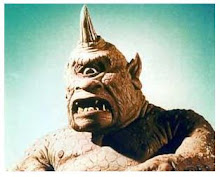
Click, gets larger, clearer.
From an advertisement for the
Sony Playstation 3 videogame platform.
From an advertisement for the
Sony Playstation 3 videogame platform.
=======================
Tibbets commanded the 509th Composite Group of B-29 Superfortress bombers. American forces had captured the Pacific island of Tinian from the Japanese. Tinian was a key pre-invasion prize, with airstrips within round-trip bombing range of Japan's home islands. A relentless program of conventional bombing raids commenced immediately; Tinian blossomed into the world's busiest military air base.
After stateside training in the Utah desert, the 509th arrived on Tinian in spring 1945 and set up in a remote corner of the tiny island, shrouded in mysterious security. What glimpses of its operations ordinary bomber wings could get seemed strange, almost senseless. Each day a trio of B-29s would fly to Japan, drop one huge conventional bomb, and return. But clearly the 509th received top-priority attention from the highest Air Force levels. Before August, a song by an anonymous bard was sung widely on Tinian.
Nobody Knows
Into the air the secret rose,
Where they're going, nobody knows.
Tomorrow they'll return again,
But we'll never know where they've been.
Don't ask us about results or such,
Unless you want to get in Dutch.
But take it from one who is sure of the score,
The 509th is winning the war.
When the other Groups are ready to go,
We have a program of the whole damned show.
And when Halsey's 5th shells Nippon's shore,
Why, shucks, we hear about it the day before.
And MacArthur and Doolittle give out in advance,
But with this new bunch we haven't a chance.
We should have been home a month or more,
For the 509th is winning the war.
===========
In a message dated 11/1/2007 1:26:40 PM Central Standard Time, bobmerk@earthlink.net writes: Before August, a song by an anonymous bard was sung widely on Tinian. troglodite writes: That's one I never ran across in any of the many books I read. Where did you come across it or were you there? ==================
Only in my dreams. Lots of people my vintage have them. Science that creeps into your id at night.
My guess is I first ran across this ditty in "Lawrence and Oppenheimer" (1968) by Nuel Pharr Davis, but when I went Googling last night, "the 509th is winning the war" returned dozens of hits.
I can't recommend "Lawrence and Oppenheimer" highly enough, it's not just superbly researched, but very rich in the human dimension of the amazing characters who thought up, built and delivered the thing that changed the world. A dozen excellent books about the first bombs have been published since, and each benefits from a new decade's declassifications. "L&O" has a very different virtue: It was written while most of the central figures were still alive and could be interviewed.
About 15 years ago in a used book store, I plotzed (soiled self) when "The Los Alamos Primer: The First Lectures on How to Build an Atomic Bomb" by Robert Serber leapt out at me.
I plotzed because I was reading blueprints, diagrams and detailed DIY instructions on how to build a fission bomb. By the time Serber published LAP in 1992 (University of California Press), probably the only thing still highly classified was the exact amount of fissile material you need to go critical.
Please give yourselves a thrill and a treat and read Serber's "Los Alamos Primer." Serber (1909-1997) was among the youngest scientists "abducted" by the Los Alamos bomb lab. He was a protege of Oppenheimer, who picked him for a key assignment. Serber introduced every new lab arrival to every scientific fact that was known so far about bomb fission.
His mimeographed lecture notes, with his added extraordinarily candid memoirs, are about as close as a schlub like me will ever get to being a fly on the Los Alamos wall.
And kids -- don't try this at home!
How close to achieving a fission weapon could an amateur or subnational "actor" be today? Though also a little out of code, probably the most thorough discussion of this very troubling question is "The Curve of Binding Energy: A Journey into the Awesome and Alarming World of Theodore B. Taylor," originally a 1974 New Yorker article by John McPhee.
Taylor was a Los Alamos bomb designer in the era after World War II, and specialized in miniaturizing fission weapons -- the very interesting and topical question: How small can it be?
Taylor also teamed with Freeman Dyson on Project Orion, the visionary scheme to use fission weapons as engines for interplanetary and interstellar travel. Prophesy isn't really all that magical a gift. Intellect, imagination, education, and a little creativity earn you 90 percent of a Nostradamus certificate. Taylor and Dyson are remarkably prophetic guys, and for half a century have regularly been the first to reach or see things that, for everybody else, only exists in Tomorrow.
Two startling answers stand out.
* Before the industrially massive Oak Ridge and Hanford facilities, the only source for fissile Uranium 235 came from Ernest Orlando Lawrence's "Big Science" cyclotron and calutron atom smashers, which used state-of-the-art powerful electromagnets to separate different nuclides literally atom by atom, and deposite the U235 as smudges on strips of paper. It was the first and certainly the most inefficient and slowest possible way to accumulate weapons-grade fissile material.
One physicist from Lawrence's Berkeley lab tried to explain a fundamental law of experimental physics (circa Manhattan Project) to the journalist. This is very close to what he said:
"You won't believe or understand this, but it's true, it's the way things really were: You can achieve any desired result in physics or chemistry if you have an unlimited amount of money to spend."
And in those war-crisis days, Lawrence and Groves could pick up the phone, call Washington, and get any bizarre amount -- or. if he wished, a truckload of gold ingots at the loading dock -- instantly. A few weeks later, voila: the world's only perceivable samples of U-235 were flying from Berkeley to Los Alamos, even though Lawrence's methods practically violated the known laws of physics and chemistry.
That has immediate consequences to the question of non-state "actors" achieving a fission bomb. We tend to comfort ourselves by emphasizing bottlenecks and treaty prohibitions in acquiring rare and highly controlled and restricted materials and equipment.
But access to money is actually the much more pertinent question. With huge sums of money, all things are possible.
* The other startling conclusion from the Manhattan days is that when the Manhattan Project (actually the Manhattan District) began, nothing was known, and everything had to be investigated and answered and discovered. Even the certain Yes/No answer to the fundamental question: Is an atomic bomb possible? was unknown.
That changed once and forever on 16 July 1945. Now, anyone who wants to build a fission bomb has been saved about 80 percent of the cost of the 19 kiloton Trinity bomb -- just by knowing already that it can be done. 80 percent of a bomb-maker's research and development costs have already been paid for and underwritten by the US and UK WWII-era governments.
We invented the wheel and proved it rolls. It never has to be invented a second time; you can skip research and development and go directly into production. Everything else (like the precise required minimum of fissile material) is relatively small details, a scary amount of it "Eagle Scout" level. Almost all the declassified knowledge was declassified because it was already common knowledge to the worldwide technical and scientific community.
Pakistan in particular demonstrated that a 1980 bomb program can succeed with surplus, hopelessly old-fashioned 1940s technology -- and an enormous amount of patience. We desperately needed our bomb before the Germans built theirs.
But to Pakistan, India will always be across the frontier. Pakistan (and India and Iran, and apparently Syria) will always have time to watch hundreds of ancient pre-owned centrifuges separate nuclides in gas form.
Rocket science deserves to be called rocket science. Bomb science isn't rocket science.
And like horseshoes, close counts, a lot. Even a disappointing dud that fails to go full incandescent mushroom leaves The Mother Of All Long-Lasting Messes. Taking into account a non-state actor's ultimate motives and aims, failure is success.
I'm also very fond of Lansing Lamont's "Day of Trinity" (1965). As time keeps rolling on -- and pivotal figures like Tibbets slip beyond the horizon -- it's very possible no one will ever write better, more detaiiled or more authentic books than the books that were written in the shadow of the first bombs. You can only be chatty or gossipy or candid or revealing while you're alive.
We have a program of the whole damned show.
And when Halsey's 5th shells Nippon's shore,
Why, shucks, we hear about it the day before.
And MacArthur and Doolittle give out in advance,
But with this new bunch we haven't a chance.
We should have been home a month or more,
For the 509th is winning the war.
===========
In a message dated 11/1/2007 1:26:40 PM Central Standard Time, bobmerk@earthlink.net writes: Before August, a song by an anonymous bard was sung widely on Tinian. troglodite writes: That's one I never ran across in any of the many books I read. Where did you come across it or were you there? ==================
Only in my dreams. Lots of people my vintage have them. Science that creeps into your id at night.
My guess is I first ran across this ditty in "Lawrence and Oppenheimer" (1968) by Nuel Pharr Davis, but when I went Googling last night, "the 509th is winning the war" returned dozens of hits.
I can't recommend "Lawrence and Oppenheimer" highly enough, it's not just superbly researched, but very rich in the human dimension of the amazing characters who thought up, built and delivered the thing that changed the world. A dozen excellent books about the first bombs have been published since, and each benefits from a new decade's declassifications. "L&O" has a very different virtue: It was written while most of the central figures were still alive and could be interviewed.
About 15 years ago in a used book store, I plotzed (soiled self) when "The Los Alamos Primer: The First Lectures on How to Build an Atomic Bomb" by Robert Serber leapt out at me.
I plotzed because I was reading blueprints, diagrams and detailed DIY instructions on how to build a fission bomb. By the time Serber published LAP in 1992 (University of California Press), probably the only thing still highly classified was the exact amount of fissile material you need to go critical.
Please give yourselves a thrill and a treat and read Serber's "Los Alamos Primer." Serber (1909-1997) was among the youngest scientists "abducted" by the Los Alamos bomb lab. He was a protege of Oppenheimer, who picked him for a key assignment. Serber introduced every new lab arrival to every scientific fact that was known so far about bomb fission.
His mimeographed lecture notes, with his added extraordinarily candid memoirs, are about as close as a schlub like me will ever get to being a fly on the Los Alamos wall.
And kids -- don't try this at home!
How close to achieving a fission weapon could an amateur or subnational "actor" be today? Though also a little out of code, probably the most thorough discussion of this very troubling question is "The Curve of Binding Energy: A Journey into the Awesome and Alarming World of Theodore B. Taylor," originally a 1974 New Yorker article by John McPhee.
Taylor was a Los Alamos bomb designer in the era after World War II, and specialized in miniaturizing fission weapons -- the very interesting and topical question: How small can it be?
Taylor also teamed with Freeman Dyson on Project Orion, the visionary scheme to use fission weapons as engines for interplanetary and interstellar travel. Prophesy isn't really all that magical a gift. Intellect, imagination, education, and a little creativity earn you 90 percent of a Nostradamus certificate. Taylor and Dyson are remarkably prophetic guys, and for half a century have regularly been the first to reach or see things that, for everybody else, only exists in Tomorrow.
Two startling answers stand out.
* Before the industrially massive Oak Ridge and Hanford facilities, the only source for fissile Uranium 235 came from Ernest Orlando Lawrence's "Big Science" cyclotron and calutron atom smashers, which used state-of-the-art powerful electromagnets to separate different nuclides literally atom by atom, and deposite the U235 as smudges on strips of paper. It was the first and certainly the most inefficient and slowest possible way to accumulate weapons-grade fissile material.
One physicist from Lawrence's Berkeley lab tried to explain a fundamental law of experimental physics (circa Manhattan Project) to the journalist. This is very close to what he said:
"You won't believe or understand this, but it's true, it's the way things really were: You can achieve any desired result in physics or chemistry if you have an unlimited amount of money to spend."
And in those war-crisis days, Lawrence and Groves could pick up the phone, call Washington, and get any bizarre amount -- or. if he wished, a truckload of gold ingots at the loading dock -- instantly. A few weeks later, voila: the world's only perceivable samples of U-235 were flying from Berkeley to Los Alamos, even though Lawrence's methods practically violated the known laws of physics and chemistry.
That has immediate consequences to the question of non-state "actors" achieving a fission bomb. We tend to comfort ourselves by emphasizing bottlenecks and treaty prohibitions in acquiring rare and highly controlled and restricted materials and equipment.
But access to money is actually the much more pertinent question. With huge sums of money, all things are possible.
* The other startling conclusion from the Manhattan days is that when the Manhattan Project (actually the Manhattan District) began, nothing was known, and everything had to be investigated and answered and discovered. Even the certain Yes/No answer to the fundamental question: Is an atomic bomb possible? was unknown.
That changed once and forever on 16 July 1945. Now, anyone who wants to build a fission bomb has been saved about 80 percent of the cost of the 19 kiloton Trinity bomb -- just by knowing already that it can be done. 80 percent of a bomb-maker's research and development costs have already been paid for and underwritten by the US and UK WWII-era governments.
We invented the wheel and proved it rolls. It never has to be invented a second time; you can skip research and development and go directly into production. Everything else (like the precise required minimum of fissile material) is relatively small details, a scary amount of it "Eagle Scout" level. Almost all the declassified knowledge was declassified because it was already common knowledge to the worldwide technical and scientific community.
Pakistan in particular demonstrated that a 1980 bomb program can succeed with surplus, hopelessly old-fashioned 1940s technology -- and an enormous amount of patience. We desperately needed our bomb before the Germans built theirs.
But to Pakistan, India will always be across the frontier. Pakistan (and India and Iran, and apparently Syria) will always have time to watch hundreds of ancient pre-owned centrifuges separate nuclides in gas form.
Rocket science deserves to be called rocket science. Bomb science isn't rocket science.
And like horseshoes, close counts, a lot. Even a disappointing dud that fails to go full incandescent mushroom leaves The Mother Of All Long-Lasting Messes. Taking into account a non-state actor's ultimate motives and aims, failure is success.
I'm also very fond of Lansing Lamont's "Day of Trinity" (1965). As time keeps rolling on -- and pivotal figures like Tibbets slip beyond the horizon -- it's very possible no one will ever write better, more detaiiled or more authentic books than the books that were written in the shadow of the first bombs. You can only be chatty or gossipy or candid or revealing while you're alive.