Search This Blog

19 September 2007

Super Typhoon Wipha misses Shanghai / Weather Porn / Climate Porn / Tropical Cyclones

Click image for larger, clearer.

In recent years, the way the world media reports events like this has been referred to as Weather Porn or Climate Porn. I suppose there are two reasons there's a huge public appetite for it, even the killer events that aren't anywhere near us.

First, it's just awesome, beyond subjectivity or debate, unimaginably more powerful and destructive than the most ambitious and malignant efforts of human beings -- including our nuclear weapons. Perhaps if we detonated all our nuclear weapons simultaneously in one spot in one ocean, it might jiggle the Power meter somewhat reminiscent of a small tropical cyclone.

The other reason is that a tropical cyclone -- Wipha (a Thai female name) is the first I've ever seen referred to as a Super Typhoon -- or an earthquake or a tsunami or a major volcanic eruption isn't anybody's fault. No evil or greedy human beings caused it. It lacks the disgusting shame and moral collapse of Darfur or Iraq or the attacks of 9/11/01 or the Balkans wars and ethnic cleansings. A comparable amount of human beings can be killed or be dislocated, but no human being picked up a phone and ordered it, or failed to prevent it. There is something authentically refreshing about staggering damage which is Not Our Fault.

Arguably, for the last century or two, collective human actions and failures to act have shaped and accellerated and worsened Weather and Climate Porn. So there is indeed a moral and ethical dimension even to a Super Typhoon. And there is certainly a deep moral and ethical dimension to how governments evacuate and safeguard Weather Porn victims before and during these events and rebuild and restore their lives after these events have done their worst (e.g., Katrina and FEMA's Mike Brown and his Helluva Job).

But Krakatau was nobody's fault; no Dr. Evil or Lex Luthor schemed to erupt it. It gave little clear warning and erupted when it felt like erupting, and erupted as violently as it felt like being violent. Its power was such that if you survived it and lived to old age, you deserved a new nickname: Lucky. Where it once was, a small, smoking new volcano, Anak Krakatau
-- Krakatau's Daughter -- has arisen. Watch This Space for further developments.

Weather Porn and Climate Porn are reminders -- which arrogant and ignorant people seem constantly to require -- that human beings are insignificant. Any man can be a King, and any King can order the incoming Tide to go out.

But it doesn't.

Nathaniel Bowditch (1773 - 1838) was arguably the world's best merchant navigator and sea captain, and many times brought his ship safely into dangerous ports on stormy nights while all other skippers cautiously rode out the night and the storm miles out to sea. He believed the arts and sciences of navigation could all be understood and mastered by any diligent person of intelligence, and in 1802 published his first edition of "The American Practical Navigator," which the U.S. Navy Hydrographic Office has updated and kept publishing ever since.

Not as a sentimental anachronism or historical curiosity. Decade after decade, it has stood between bringing people safe home to dry land, and drowning at sea. It's the greatest reference book about Terrible Weather ever published, and has a chapter entirely about Tropical Cyclones. Bowditch wrote:

"Rarely does the mariner
who has experienced
a fully
developed
tropical cyclone at sea

wish to encounter
a second one."


Most of Chapter XXXIX are instructions about how to steer clear of them. Notice the narrow cyclone-free band along the Equator. When the radio starts crackling with tropical cyclone warnings, set course for the Equator.

* * *

EuroNews (France)
Wednesday 19 September 2007
13:10 Central European Time


It lost power after arriving in eastern China but, for those in its path, Super Typhoon Wipha was still a force to be reckoned with. More than two million people fled ahead of the storm. It toppled hundreds of homes and knocked out power and water supplies as it swept in from the sea. At least one man has died after being electrocuted in Shanghai. But fears the financial centre would take a direct hit look to have been allayed. Wipha made landfall at the border of Zhejiang and Fujian provinces, just where a typhoon hit last year, killing hundreds of people.

As Wipha approached, residents left their homes and workplaces to take refuge in shelters. "We heard the typhoon was coming," said one man, forced to flee to safety. "And the company we work for evacuated us to this school."

Northern Taiwan was also grazed by Wipha which reports say has now been downgraded to a tropical storm. But the alert is not over yet and, according to the Chinese media, some 40,000 boats and ships have been ordered back to port.

18 September 2007

unclaimed Semitic Pizza

Oh, go ahead and click if you need it bigger.

There are currently 2 unsolved PizzaQs involving Semitic languages.

One, a detail of a wood sculpture of a Qur'an passage, is ... well, maybe hopeless.

EXCEPT that when it was set as a puzzle on the photographer's website, SOMEBODY (about the 40th person who tried) guessed the answer correctly!

So don't despair. Keep trying.

But this one, my new pump tatt, two lousy words in Hebrew, clearly spelled, writ large ... Even in the first post, it was just reeking with clues.

The top word would be immediately familiar to any modern Israeli adult. Possibly this word *isn't* a common word in ancient (Biblical) Hebrew. But it's very common in modern Israeli secular spoken and written Hebrew.

The bottom word -- much more globally portable and famous, and was probably first an Arabic word, still today very familiar all over the Middle East. Same word is very commonly transliterated into the Roman alphabet and so is a well-known word all over Western Europe and North America. Betcha Cyrillic knows it very well, too.

Hint Hint notice also the visual design and color of the tatt Hint Hint Clue Klew.

To really rub it in, I copied these two words from an image of a big-ass banner that was hanging in broad daylight on a street, probably in Tel Aviv. In that original, each letter was probably 2 meters tall.

This is simply NOT a shy or an obscure thing.


Now I'll throw in the Hebrew/Ivrit alephbet just to make it Kindergarten simple.

So where are the vowels? Does this say Ooooo Ayyy? Or Eeeeee Ahhh?

In modern Hebrew, and likewise in Yiddish, which uses this same alephbet, only the Little Kiddies need vowels. Grown-up people just KNOW what the proper vowel sounds are.

I don't know why the IT Guy from the USA state shaped like the palm of the right hand hasn't claimed his pizza. It's just New Year's, I don't think it's Yom Kippur yet.

But SOMEBODY should be able to figure this out. It's just about as easy as the Dr. Evil PizzaQ.

trails of stars that never set as they circle the South Pole

Click once or twice. In some magnifications, the concentric circles will generate shimmering Moire interference patterns -- not an inherent phenomenon of the stars and star tracks themselves, but a common optical illusion of dense sets of curves.

Image and text © 1979 Anglo-Australian Observatory, photograph by David Malin.

By pointing a camera towards the south (or to the north in the northern hemisphere) at night, we can record the paths of stars which never set. They appear to circle the apparent position of the Earth's axis of rotation projected on the sky. The elevation of this position above the local horizon indicates our local geographical latitude, about 30 degrees south at Siding Spring. The angle swept out by the arcs is an indication of the exposure time, which was about 10.5 hours on 400 ISO colour film. This kind of exposure is only possible from an extremely dark site. More information on relationship between the measurement of time and star trails is in the caption to a similar picture here.

During the long winter nights observers using AAT occasionally peer outside to inspect the weather and as they walk around the dome their lights produce the irregular lines at the catwalk level. The upper part of the dome is however illuminated by the light of the natural night sky and stars alone.

~ ~ ~

The Anglo-Australian Observatory is in Siding Springs, New South Wales, Australia. Hire a car in Sydney and drive northwest. Keep driving. Drive some more. Stop when you get to a town called Coonabarabran, then ask for directions to the observatory.

This world-class telescope for the Southern Skies is there because they need dark skies, and dark skies are now only to be found far from cities.

In school when you learn about the goddesses and gods and heroes and heroines and animals and monsters who live in the night sky, you usually don't understand what they're talking about. The stories are from an age long past when the skies were so clear that the connect-the-stars pictures screamed bears and serpents and scorpions, archers, huntresses, chariots, queens. Everyone could see them all on two hundred nights of the year, and it only took a little storytelling coaxing to make them all come alive.

Now a night sky like that is an extremely rare event for most people, and it's startling. I've seen such skies in the Australian desert in Alice Springs, and on ships in the Atlantic, the North Sea and the Baltic.

This is the slow and silent theft, a robbery so slow that we didn't even notice something of spectacular value was being taken from all of us, so no one ever called the police or complained to the government. Most of us live in and around cities, and most of the damage is caused by a century of the artificial light from cities and suburbs and industrial zones.

The International Dark Sky Association works to return this heritage to us, not by plunging us into darkness, but by shifting our artificial lights to kinds of lights that produce wavelengths that don't corrupt our view of the night skies, and aiming our lights carefully, to illuminate just those near-ground things for our safety. We don't need to illuminate the skies above us to be safe at night.

In a few weeks the polar bears will migrate through and around the town of Churchill, Manitoba on Hudson Bay in Canada. You can take a spectacular old train from Winnipeg through the wilderness, two and a half days in each direction, to get there. Churchill is also said to be the best spot on Earth to see the Northern Lights, the Aurora Borealis, most active and intense during the winter.

One night in the woods outside Miletus (in modern Turkey), the world's first full-time philosopher, Thales, fell down a well. He yelled for help until a slave girl heard his cries and helped haul him out. She asked him what had happened, and he said he'd been walking around looking up at the sky. "You old fool," she yelled at him. "You were paying so much attention to the stars you didn't see where your feet were going!"

But in those days, there was so much to see by looking up at night. Millions of fixed stars. Five wandering planets you could see with the naked eye. Some of them would go in one direction for months, and then stop, and then go in the opposite direction for a while. The Moon, of course, in all its waxing and waning phases. And oddball transient things that came and went, appeared and disappeared without warning -- comets, meteors, amd flocks of shooting stars a few predictable nights of the year. Sometimes the full Moon would turn blood red and disappear without warning, and then come back. During the day, now and then the Sun would vanish and return, too.

And you were there to see it all and wonder what it all was and what it all meant and why it behaved like that. Sometimes things so strange and beautiful that parents would wake their little children and take them outside to see them in the middle of the night.

Now we know what most of it is and what most of it means and why most of it behaves like that. We just can't see very much of it anymore.

17 September 2007

it was about OIL??? Noooooooooooooo! That's a lie! He's lying!

Most heart attacks happen on Monday morning. Are you sitting down? Take a few deep breaths. Take a Valium if you have one.

Jeez -- the Big Guy told us this was about Freedom and Democracy and Fighting Terrorists and Weapons of Mass Destruction. I can't believe it was about something else. Color me megashocked.

Oh yes, I should mention. Last week the price of crude oil on the world market hit an all-time record high of U$80 a barrel.

This Decider Guy could fuck up a wet dream.

* * *

Agence France-Presse (founded 1835)
Monday 17 September 2007

Greenspan memoir
links Iraq war
to US thirst for oil

WASHINGTON (AFP) — Former Federal Reserve chairman Alan Greenspan, for years an inscrutable seer on the economy, is causing a stir by alleging in his new memoir that "the Iraq war is largely about oil."

Greenspan, who as head of the US central bank was famous for his tight-lipped reserve, is uncharacteristically direct, also accusing President George W. Bush of abandoning Republican principles on the economy.

"I'm saddened that it is politically inconvenient to acknowledge what everyone knows -- the Iraq war is largely about oil," he wrote in reported excerpts of "The Age of Turbulence: Adventures in a New World," which is set for release on Monday.

However in an interview with The Washington Post, Greenspan clarified that while securing global oil supplies was "not the administration's motive," it had presented the White House with an opportunity to make the case that removing Saddam Hussein was important for the global economy.

"I was not saying that that's the administration's motive," he said in the interview. "I'm just saying that if somebody asked me, 'Are we fortunate in taking out Saddam?' I would say it was essential."

Greenspan's memoir appears 18 months after he left the Fed, following a career that spanned 1987 to 2006, with the US economy at a crossroads and ahead of a critical central bank meeting under the chairmanship of his successor, Ben Bernanke.

The man dubbed "The Oracle" tells his own tale of nearly two decades at the helm of one of the world's most powerful financial institutions and includes surprising swipes at the Bush administration.

US Defense Secretary Robert Gates, while explaining his "respect" for Greenspan, rejected the charge that a thirst for crude explained the decision to invade Iraq in March 2003.

"I know the same allegation was made about the Gulf War in 1991, and I just don't believe it's true," he said on ABC television Sunday.

Members of the US Congress, who by a broad majority also voted to authorize the use of military force against Iraq, also dismissed Greenspan's assertion.

"I don't believe that 77 United States senators on a broad, bipartisan basis would have authorized the use of force ... if it was only about oil," Republican Senator John Cornyn (Texas) told CNN.

Greenspan, a lifelong Republican, writes that he advised the White House to veto some bills to curb "out-of-control" spending while the Republicans controlled Congress.

According to The Wall Street Journal, he says that Bush's failure to do so "was a major mistake."

Republicans in Congress, he writes, "swapped principle for power. They ended up with neither."

"They deserved to lose" in the 2006 elections when the Democrats retook control of Congress, he adds.

A speech by the 81-year-old Greenspan is said to command more than U$100,000, and he reportedly earned a U$8,500,000 advance from Penguin Press for the book.

In the bombshell memoir, he puts his own spin on the events surrounding the 1987 stock market crash, the bursting of the Internet bubble and the 2001 recession coinciding with the September 11 terror strikes.

In a blog on the online bookstore Amazon.com, Greenspan says he will share details of his childhood in New York, his years as a jazz musician and his friendship with US presidents.

"After years of talking 'Fedspeak' in carefully calibrated congressional testimony, I could finally use my own voice," Greenspan says with uncharacteristic verve.

"I tackled the personal part first, but then started unraveling the detective story about the economy," Greenspan adds in his blog. "What did all the economic shifts we began to detect in the late 90s mean?"

His memoirs are due out just as the institution he led for so many years holds its most anticipated meeting in years.

On Tuesday, investors around the world will be closely watching the Fed for some sign that might help counter the effects of a US mortgage crisis that has rattled markets and led to a credit squeeze.

Greenspan is increasingly being blamed by some for the crisis. By keeping interest rates so low for so long, some argue, he helped foster the real estate bubble behind much of the current woes.

The former Fed chief said the fall in US housing prices triggered by the subprime credit crisis would likely be bigger than expected.

The drop in property prices "is going to be larger than most people expect," Greenspan told the Financial Times, adding that he would not be surprised if the percentage decline in the United States ended up being "in double digits."

- 30 -

Copyright © 2007 AFP. All rights reserved.

15 September 2007

bunch of anger about the liars' & scoundrels' War Without End, Amen / a dangerous pervert plays global security poker with other peoples' chips

Some crummy old wine from Vleeptron:

==============

Those who have not been soldiers tend to overlook the obvious about soldiers: They are as talented and diverse a bunch of men and women as civilians. In most wars most of them are just civilian "temps" forced into a few years of pretending to act and think like soldiers.

But in or out of uniform, they are pianists, singers, actors, baseball and football players, tango and ballet dancers, painters, dreamers, astronomers, mathematicians, writers, poets, chefs de cuisine, cowgirls and cowboys.

In a fascinating radio documentary about the US Navy aircraft carrier John C. Stennis -- a floating medium-sized city -- on war duty in the Arabian Sea revealed its bowels infested with amateur rock bands, rehearsing as far as possible from crew sleeping quarters, the music echoing down every corridor. Jimi Hendrix began his musical career playing guitar at military clubs at Fort Campbell, Kentucky, where he served as a paratrooper in the 101st Airborne Division. When not playing popular music, he spent his time jumping out of airplanes with full pack and infantry rifle.

==============

Good writers. Some soldiers are good, even great writers. It would have been nice, it would have been very valuable, to have heard more from these two soldiers if they'd lived through the Iraq War.

=================

The Associated Press (newswire USA)
Thursday 13 September 2007

[image] Olga Capetillo cries as she holds her favorite family snapshot of her son Sgt. Omar Mora with his daughter Jordan at her home Wednesday, Sept. 12, 2007 in Texas City, Texas. Mora, a co-author of an Aug. 19, 2007 New York Times op-ed critical of the Pentagon's positive assessment of the Iraq war, was killed Monday in a vehicle accident in Iraq that also claimed the lives of six other U.S. soldiers, and two detainees.. (AP Photo/Pat Sullivan)

2 Soldiers Who Wrote
Op-Ed Died in Iraq

by Monica Rhor

TEXAS CITY, Texas (AP) — Two sergeants who helped write a New York Times op-ed article sharply critical of the Pentagon's assessment of the Iraq war were killed in a Baghdad crash this week, and one grieving mother wants the Army to explain their deaths.

"I want to know all the details of how he died. I want to know the truth," said Olga Capetillo, whose 28-year-old son, Sgt. Omar Mora, died Monday along with six other soldiers and two detainees. "I don't understand how so many people could die in that accident. How could it be so bad?"

Mora and co-author Sgt. Yance T. Gray, 26, of Ismay, Mont., died Monday when their truck veered off an elevated highway in western Baghdad and fell about 30 feet, the military said. The single-vehicle crash also wounded 11 other soldiers and a detainee.

The military made no mention of hostile fire. A call to an Army spokesman seeking comment Wednesday was not immediately returned.

U.S. Sen. Max Baucus, D-Mont., also said he was asking the military for details of Gray's death.

Since writing the critical Aug. 19 article with six other active duty U.S. soldiers, she said Mora had seemed increasingly depressed and withdrawn.

"I said to him: 'Son, I don't want you to have problems because of this. Hopefully, nothing will happen,'" said a grief-stricken Capetillo, speaking in Spanish.

The Times piece, called "The War As We Saw It," expressed doubts about American gains in Iraq. "To believe that Americans, with an occupying force that long ago outlived its reluctant welcome, can win over a recalcitrant local population and win this counterinsurgency is far-fetched," the group wrote.

In the last line, the authors reaffirmed their commitment: "We need not talk about our morale. As committed soldiers, we will see this mission through."

Another co-author, Staff Sgt. Jeremy Murphy, was shot in the head Aug. 12 while the op-ed was being written. The Army Ranger and reconnaissance team leader flown to a military hospital in the United States and expected to survive.

Mora and Gray, members of the 82nd Airborne Division, joined the military out of a sense of duty and selflessness, people who knew them said. Both were married and leave behind young daughters.

Mora, a permanent legal resident, received his citizenship papers two weeks ago and was waiting to be sworn as a U.S. citizen when his deployment ended in November.

"My son gave his life for this country. He was proud of this country, even though he was not an American yet," said Capetillo, who emigrated from Ecuador when Mora was 2.

Yet Capetillo said Mora seemed to grow disturbed by the poverty and pain afflicting Iraqi children and often asked his family to send cookies and candies for the youngsters.

In April, he came home for two weeks to recover after his ears were damaged by a roadside bomb. Then in August, a friend died in Mora's arms, leaving a grim imprint, Capetillo said. An unusually subdued Mora had called his mother Friday, and the two spoke for what would be the last time.

"He was so quiet, as if he did not want anyone to hear him," said Capetillo, as family and friends encircled her in her Texas City kitchen. "I told him that I was counting the days until he would come home, that I would give him a big hug."

Mora told his mother that he was very tired.

"Maybe he had a premonition that something was going to happen to him, that he was not going to come back," said Capetillo, as tears moistened her face. "My son escaped death two times before. But this time, no."

Gray, who grew up on a ranch outside the town of 25 residents, graduated with a class of just 18 from Plevna High School. He and four fellow students joined the military, and news of his death spread quickly, school secretary Lynette O'Connor said.

Gray's relatives said the he felt so strongly about the Army that he reenlisted two or three years ago. He loved being in uniform, and they said writing the op-ed piece must have been a difficult decision.

"I thought it was pretty brave of them to do that," said Marge Griebel, who is married to Gray's grandfather. "It is good that some of us people back here can hear some of those things. They must have put a lot of thought and time into that letter before they put it out."

Griebel called Gray a hero and said the family was grief-stricken.

"It was something they knew could happen, but they just kept praying that it won't," she said.

- 30 -

Associated Press writer Matt Gouras in Helena, Montana contributed to this report.

Copyright © 2007 The Associated Press. All rights reserved.

===============

The New York Times
Sunday 19 August 2007

Op-Ed Column:

The War as We Saw It

by Buddhika Jayamaha, Wesley Smith, Jeremy Roebuck, Omar Mora, Edward Sandmeier, Yance Gray, Jeremy Murphy

August 19, 2007, Baghdad, Iraq -- VIEWED from Iraq at the tail end of a 15-month deployment, the political debate in Washington is indeed surreal. Counterinsurgency is, by definition, a competition between insurgents and counterinsurgents for the control and support of a population. To believe that Americans, with an occupying force that long ago outlived its reluctant welcome, can win over a recalcitrant local population and win this counterinsurgency is far-fetched. As responsible infantrymen and noncommissioned officers with the 82nd Airborne Division soon heading back home, we are skeptical of recent press coverage portraying the conflict as increasingly manageable and feel it has neglected the mounting civil, political and social unrest we see every day. (Obviously, these are our personal views and should not be seen as official within our chain of command.)

The claim that we are increasingly in control of the battlefields in Iraq is an assessment arrived at through a flawed, American-centered framework. Yes, we are militarily superior, but our successes are offset by failures elsewhere. What soldiers call the “battle space” remains the same, with changes only at the margins. It is crowded with actors who do not fit neatly into boxes: Sunni extremists, Al Qaeda terrorists, Shiite militiamen, criminals and armed tribes. This situation is made more complex by the questionable loyalties and Janus-faced role of the Iraqi police and Iraqi Army, which have been trained and armed at United States taxpayers’ expense.

A few nights ago, for example, we witnessed the death of one American soldier and the critical wounding of two others when a lethal armor-piercing explosive was detonated between an Iraqi Army checkpoint and a police one. Local Iraqis readily testified to American investigators that Iraqi police and Army officers escorted the triggermen and helped plant the bomb. These civilians highlighted their own predicament: had they informed the Americans of the bomb before the incident, the Iraqi Army, the police or the local Shiite militia would have killed their families.

As many grunts will tell you, this is a near-routine event. Reports that a majority of Iraqi Army commanders are now reliable partners can be considered only misleading rhetoric. The truth is that battalion commanders, even if well meaning, have little to no influence over the thousands of obstinate men under them, in an incoherent chain of command, who are really loyal only to their militias.

Similarly, Sunnis, who have been underrepresented in the new Iraqi armed forces, now find themselves forming militias, sometimes with our tacit support. Sunnis recognize that the best guarantee they may have against Shiite militias and the Shiite-dominated government is to form their own armed bands. We arm them to aid in our fight against Al Qaeda.

However, while creating proxies is essential in winning a counterinsurgency, it requires that the proxies are loyal to the center that we claim to support. Armed Sunni tribes have indeed become effective surrogates, but the enduring question is where their loyalties would lie in our absence. The Iraqi government finds itself working at cross purposes with us on this issue because it is justifiably fearful that Sunni militias will turn on it should the Americans leave.

In short, we operate in a bewildering context of determined enemies and questionable allies, one where the balance of forces on the ground remains entirely unclear. (In the course of writing this article, this fact became all too clear: one of us, Staff Sergeant Murphy, an Army Ranger and reconnaissance team leader, was shot in the head during a “time-sensitive target acquisition mission” on Aug. 12; he is expected to survive and is being flown to a military hospital in the United States.) While we have the will and the resources to fight in this context, we are effectively hamstrung because realities on the ground require measures we will always refuse — namely, the widespread use of lethal and brutal force.

Given the situation, it is important not to assess security from an American-centered perspective. The ability of, say, American observers to safely walk down the streets of formerly violent towns is not a resounding indicator of security. What matters is the experience of the local citizenry and the future of our counterinsurgency. When we take this view, we see that a vast majority of Iraqis feel increasingly insecure and view us as an occupation force that has failed to produce normalcy after four years and is increasingly unlikely to do so as we continue to arm each warring side.

Coupling our military strategy to an insistence that the Iraqis meet political benchmarks for reconciliation is also unhelpful. The morass in the government has fueled impatience and confusion while providing no semblance of security to average Iraqis. Leaders are far from arriving at a lasting political settlement. This should not be surprising, since a lasting political solution will not be possible while the military situation remains in constant flux.

The Iraqi government is run by the main coalition partners of the Shiite-dominated United Iraqi Alliance, with Kurds as minority members. The Shiite clerical establishment formed the alliance to make sure its people did not succumb to the same mistake as in 1920: rebelling against the occupying Western force (then the British) and losing what they believed was their inherent right to rule Iraq as the majority. The qualified and reluctant welcome we received from the Shiites since the invasion has to be seen in that historical context. They saw in us something useful for the moment.

Now that moment is passing, as the Shiites have achieved what they believe is rightfully theirs. Their next task is to figure out how best to consolidate the gains, because reconciliation without consolidation risks losing it all. Washington’s insistence that the Iraqis correct the three gravest mistakes we made — de-Baathification, the dismantling of the Iraqi Army and the creation of a loose federalist system of government — places us at cross purposes with the government we have committed to support.

Political reconciliation in Iraq will occur, but not at our insistence or in ways that meet our benchmarks. It will happen on Iraqi terms when the reality on the battlefield is congruent with that in the political sphere. There will be no magnanimous solutions that please every party the way we expect, and there will be winners and losers. The choice we have left is to decide which side we will take. Trying to please every party in the conflict — as we do now — will only ensure we are hated by all in the long run.

At the same time, the most important front in the counterinsurgency, improving basic social and economic conditions, is the one on which we have failed most miserably. Two million Iraqis are in refugee camps in bordering countries. Close to two million more are internally displaced and now fill many urban slums. Cities lack regular electricity, telephone services and sanitation. “Lucky” Iraqis live in gated communities barricaded with concrete blast walls that provide them with a sense of communal claustrophobia rather than any sense of security we would consider normal.

In a lawless environment where men with guns rule the streets, engaging in the banalities of life has become a death-defying act. Four years into our occupation, we have failed on every promise, while we have substituted Baath Party tyranny with a tyranny of Islamist, militia and criminal violence. When the primary preoccupation of average Iraqis is when and how they are likely to be killed, we can hardly feel smug as we hand out care packages. As an Iraqi man told us a few days ago with deep resignation, “We need security, not free food.”

In the end, we need to recognize that our presence may have released Iraqis from the grip of a tyrant, but that it has also robbed them of their self-respect. They will soon realize that the best way to regain dignity is to call us what we are — an army of occupation — and force our withdrawal.

Until that happens, it would be prudent for us to increasingly let Iraqis take center stage in all matters, to come up with a nuanced policy in which we assist them from the margins but let them resolve their differences as they see fit. This suggestion is not meant to be defeatist, but rather to highlight our pursuit of incompatible policies to absurd ends without recognizing the incongruities.

We need not talk about our morale. As committed soldiers, we will see this mission through.

- 30 -

Buddhika Jayamaha is an Army specialist. Wesley D. Smith is a sergeant. Jeremy Roebuck is a sergeant. Omar Mora is a sergeant. Edward Sandmeier is a sergeant. Yance T. Gray is a staff sergeant. Jeremy A. Murphy is a staff sergeant.

============

Google News
Tuesday 11 September 2007

Comment by Wiliam C. Martel, Assoc. Professor of International Security Studies, Tufts University, Boston, Massachusetts USA

How to think about conditions in Iraq, General Petraeus' testimony before Congress, and what we need to do next

The Iraq war is the most critical foreign policy issue facing the American people. For moral, political, and strategic reasons, we cannot afford to suddenly, prematurely withdraw U.S. forces without plunging Iraq into a genocidal sectarian war for which we would be responsible.

For the first time, there are tangible signs of progress.

First, violence is down across Iraq, as virtually all studies show. In General Petraeus' testimony yesterday, his chart "Iraq Violence Trends" shows less violence in Baghdad and several provinces. The number of "High Profile Attacks" is down. Overall, the number of daily attacks against US/coalition forces and Iraqi civilians declined between August 2006 and now.

Here at home, violence in Iraq is the primary measure used by policymakers and citizens to judge conditions in Iraq. With the US troop surge, there are signs -- tentative, but nonetheless promising -- that something positive might be happening in Iraq.

Second, when we compare General Petraeus' briefing to Congress with other studies on Iraq, the differences are not significant. Despite differences -- reflecting disagreements about data or interpretation -- the general consensus is that violence in Iraq is down but still too high, the surge in US troops has helped, while political progress by the Iraqi government remains disappointing.

Third, signs of progress in Iraq give us an opportunity to end political warfare at home. While progress is less than what everyone wants, it provides the basis for a consensus among warring US political factions. For the good of the country, Democrats and Republicans must forge a national consensus on Iraq.

Morally, we cannot leave Iraq without being responsible for a sectarian bloodbath. Politically, we cannot abandon a state to which we committed ourselves. Strategically, we cannot afford chaos in the Middle East, which produces 20 percent of the oil we use every day.

Where do we go from here? With signs of progress, the right thing is to give Iraqis a "decent interval" for reconciliation. We must end America's national spasm of partisan politics and do the right thing for Iraq.

=================
e-mail to Professor William C. Martel, Tufts University, Boston, Massachusetts USA
=================

Is it of no consequence to you, or have you disciplined yourself to be blind to the dimension of our soldiers and Marines -- what they are, or should be, worth to the nation, and what they must endure -- in the coming years, and for the rest of their lives, if they live -- if our councils analyze the Pollyanna side of the Petraeus surge report as you have?

Did you serve? I did during Vietnam. Scholars like you helped scoundrels prolong the national agony, and bring the uniform death toll to 58,000. Are the friends I lost just sentimental ephemera to you? Are you a scholar our corridors of power should heed, while our soldiers and Marines are just inconsequential losers?

Doubtless you work hard to research and reach your policy conclusions. But you could research the dimension you seem so heedless of, any day of the week, within an easy drive from Boston, by attending the funeral of one of my neighbors' children returned in a coffin from Iraq. The family would not mind if you came to pay your respects. There you could add human grieving and loss to your understanding, and it might color your bloodless analyses.

I would not have minded my service if we had learned something from Vietnam. But again our Best and Brightest from our finest universities urge America to prolong a scoundrels' and liars' blunder war. Others risk, suffer for a lifetime, and die while you advise America to give war a chance.

Soon my town's winter homeless shelter will re-open, and as in past winters I have served the shattered from Vietnam and then from Desert Storm, I will begin to serve young men and women who stagger in at suppertime from the meatgrinder of Iraq and Afghanistan. Not long from now, some of them who might have been spared by a merciful quick end to this meaningless catastrophe can credit their ordeal to your wise counsel.

These are real people, and each of them has as much right to live, and to be spared suffering, as you.

Robert Merkin
Northampton Massachusetts

SP5, US Army 1969-1971
Army Commendation Medal

==================

another e-mail to Professor Martel:
subject: here's two funerals of soldiers killed in Iraq you can go to
==================
They had as much right to live as you do; their analysis of the Iraq War was better informed and more expert than yours. And more humane and more moral.

Unlike these guys, with their service and risk, you play war poker with other peoples' chips.

===================

Does it Matter?

by Siegfried Sassoon
from "Counter-Attack and Other Poems," 1918

Does it matter? -- losing your legs?...
For people will always be kind,
And you need not show that you mind
When the others come in after hunting
To gobble their muffins and eggs.

Does it matter ? -- losing your sight?...
There's such splendid work for the blind;
And people will always be kind,
As you sit on the terrace remembering
And turning your face to the light.

Do they matter? -- those dreams from the pit?...
You can drink and forget and be glad,
And people won't say that you're mad;
For they'll know you've fought for your country
And no one will worry a bit.

the Ramadan Kareem puzzle (continued)

Clearer and simpler Arabic calligraphy of the name of Allah. The largest is painted on the wall of the Old Mosque in Edirne, Turkey. (1999 photo by Nevit Dilmen.)

Abbas Halai said...

hey man khair mubarak. as far as guessing the sura goes, there aren't that many letters in the image to be able to make a coherent guess.

it's like me making an image like this.

a j
k abbas r
t

and asking me to guess the sura because all i can read are single letters around the word Allah and that's about it.

i'm from a very small, orthodox community that doesn't follow the sighting of the moon the mark the beginning of ramadan, instead we just use a fixed scientific lunar calendar unlike every other islamic community.

============

You can see why Arab and Persian astronomers ruled the skies for 1000 years (and gave permanent names to most of the naked-eye stars). Pegging the beginning of the holiest annual festival to being able to see a particular phase of the moon is a 44-aspirin astronomical headache.

I learned a lot about when Ramadan begins all over the world. Ramadan begins in about 300 arguments and festivals of confusion and heated controversy all over the planet. In our era, it's common as shoelaces to (try to) compute the Ramadan moon phase visibility problem with big university computers. In the Islamic world, it's a NASA-class problem of great importance to governments, nations, schools, transportation infrastructures, etc. In addition, ICOP's site had tons of images of teams scampering around the globe with portable telescopes praying for clear skies.

Yup yup what you said about the seemingly difficult Nature of this Puzzle.

(This is NOT a PizzaQ, I am trying to handle this thing with dignity and respect. All you get for the correct answer is Astonishment and Admiration.)

It's *almost* impossible to get from this image to the correct Sura.

But apparently not completely impossible. When nascity posted his image and asked his readers/viewers to try to guess the Sura, it triggered a stampede of guesses. About the 40th reply nailed it.

It takes a little Sherlock Holmes and Miss Marple thinking.

What Qur'an passage does a master wood sculptor spend a month or more of his life meticulously and laboriously carving? An obscure passage with limited interest or meaning? Or a famous, very well-known passage that is reproduced and exchanged constantly throughout the Muslim world?

For Judaeo-Christians, a puzzle like this might get them to guessing something super-familiar like the 23rd Psalm, or the first lines of the Christmas Gospel. They could skip the verses that demand you only eat fish with scales, or the verses that list 30 generations of "begats." Nobody makes a laborious art work of those.

So you're not really guessing among a huge crowd of 114 Sura or 1000 Ayat. More likely, you only have to scrutinize about 20 or 30 likely famous passages, and see which ones might match what little other information is in the image. And in fact nascity (a college grad from Boston, now a quite popular photographer in Dubai) hinted that the image he'd photographed was a well-known Sura. Fortunately for me, most (though not all) of his commenters replied in English.

I thought the image was quite gorgeous -- much lovelier than my usual dirt-ignorant Ramadan Hallmark Cards -- and Vleeptroned the question because it seemed to give so much fun and pleasure to nascity's admirers. Why should they have all the fun?

The best Huckleberry Finnstein can boast is that I *can* -- barely -- solve this kind of problem in Biblical Hebrew. But I can fantasize about learning more Arabic and someday reading a tiny bit of the Qur'an and the Alf Layla in the original. So far my familiarity is strictly with Dawood's Penguin translation of the Qur'an -- which, buzz has it, is one of the world's perpetual megabestsellers.

While we got you on the line, you *could* tell us a little bit about how you're celebrating Ramadan. (And then you could slip us a little politics gossip about what the heck's going on in PK this month.)

14 September 2007

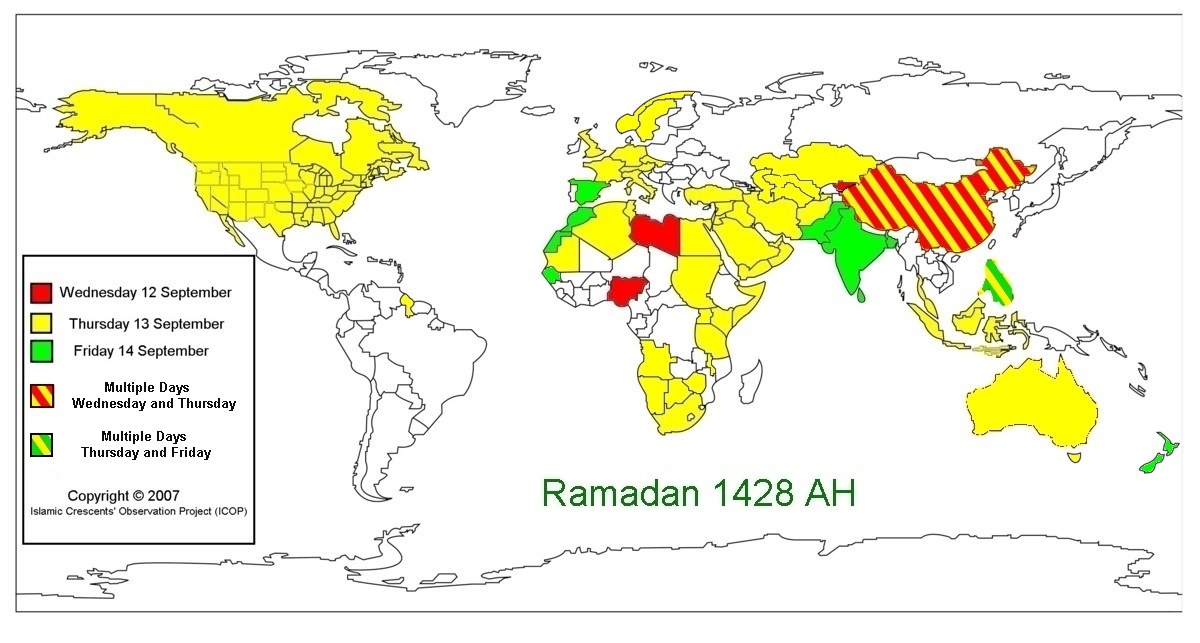
Ramadan Kareem / Ramadan 1428 AH / 2007 AD begins

Click map for larger.

TOP:
Photograph, by nascity, of part of a Sura of the Koran, the name of Allah clear in the center. nascity made everyone guess which Sura it was, dozens tried, eventually somebody guessed right. So everyone's invited to guess the Sura here, too.


BOTTOM: Map showing the start of Ramadan 1428 AH / 2007 AD throughout the world -- the sighting of a particular crescent phase of the Moon. In the USA, Canada and most of Europe, Ramadan began on Thursday 13 September. In Spain, Morocco, Pakistan and India, it began Friday. From the Islamic Crescents' Observation Project website promoted and maintained by Mohammad Odeh, Member of The Jordanian Astronomical Society (JAS) and The Emirates Astronomical Society (EAS).

2 PizzaQs! My Borg Implants / My new Tatt!

Click image, I get even sexier!

AMY was complaining that I almost never post a photo of myself anywhere in C-Space. Well, okay, first I showed myself at the Cummington Fair shaking hands with my hero, Smokey Bear.

And now, here's part of me posing as the National Poster Boy for my new Borg Implants. I'm buff and pumped! The insulin pump is clipped to my muy butch biker belt.

The other Borg Implant on the left is an on-line real-time blood glucose monitor which wi-fi's its results -- something like 10 samplings a minute -- via a radio link to the software Brane in the pump.

Historically, on-line real-time measurement of blood glucose was the most difficult medical technology breakthrough to achieve. Without it, everybody has to constantly use one of those B.B. King finger-prick test blood sugar meters.

And they hurt. Ouch. Ouch. My nurse recommends I pincushion myself and interrupt what I'm doing to take the finger-prick test from 6 to 8 times a day. Uh-huh. Sure. Starting right away. Anyway, for a person with a normal pancreas, or for a diabetic who, one way or the other, is doing a good job of balancing sugars and insulin, a Good Number is around 110, and that's in Milligrams Per Deciliter, a unit every bit as straightforward and clear to all as Furlongs Per Fortnight.

Actually these Buck Rogers Gets Diabetes in the 21st Century nifty gizmos won't evolve into an authentic Artificial Pancreas unless they also figure out how to tell the computer how much Food (specifically, carbohydrates, measured in grams) your piggish self is tossing down your Maw for a snack, or an ice cream spree at Friendly's. Until they can sense and automatically wi-fi what you're tossing down your throat to the pump, you have to manually compute (look up in a reference book, or read the carb grams from the TV dinner box) the carbs you're about to eat, and punch it into the pump. Muy Starwarz, and a major pain in the ass.

But the pump does quite an amazing and effective automated job during the rest of the day and night when you're not eating -- the slow drip of a small but constant amount of insulin called the Basal Rate. The whole trick -- the reason to get rid of your nasty old stigmatized junkie syringes and Do The Pump -- is to smooth out the daily insulin absorption curve. I just got my Numbers back (the Big One is a month-long blood glucose average called the Hemoglobin A1C Test) and they're authentically, genuinely, dramatically improved over my Spike Days. And with that improvement hitchhikes a whole raft of general improvements in my overall health. (Specifically, my kidneys are no longer careening toward Dialysis City.)

This year's Nobel Prize for Medicine and Physiology goes to the guy or gal who figured out how to talk the private health insurance providers into paying for the pump, so diabetics don't have to take a second mortgate or sell a kidney to a rich person to get a pump. In Civilized Nations -- just about every industrialized country except the USA -- health care is provided to all by the government, regardless of ability to pay. Not Free, but paid for by everybody's taxes. The dreaded Single Payer system, also known as Socialized Medicine, or Castro-Style Communism. Vote for Gus Hall!


AGENCE-VLEEPTRON PRESSE
NEWS FLASH!
HOLD PAGE ONE!

Like, where the %(*#&(#*& did this sudden Explosion in Diabetes and Obesity come from??? Suddenly Everybody and her Sister Sue has Diabetes and Everybody and his Cousin Patrice is looking for clothes in sizes XXX-Large! And that's why the blood glucose monitor manufacturers are being so generous to B.B. King in his Golden Years, because there's suddenly a Huge New Market for diabetic-related medical supplies and equipment.

Latest theory -- now they think both a lot of the Diabetes, and the Obesity Tsunami, are Viruses similar to the cold virus. Ya need a link on that? Okay I'll try to find a link on that. Try This. And This.

Ah. The Tattoo. Bob (a.k.a. the Hucklebery Finn of World Jewry) is exploring and discovering his Jewish Heritage with his new Tattoo.

PizzaQ No. 1 (2 slices with anchovies, if anchovies are Kosher):

What's wrong with this sentence?

Bob is exploring and discovering
his Jewish Heritage
with his new Tattoo.

A 3rd slice if you can cite Book, Chapter and Verse. So maybe some Divines can take a stab at this.

* * *

PizzaQ No. 2 (5 slices, capers, endives and shallots, all Parve):

What does the Tattoo say? What does that Mean? What up with that?

Mike the Irish Belgian managed to solve the Dr. Evil/Dr. Rasha דר.רשע Hebrew PizzaQ, and so did Steve Klein, IT manager for the ad agency where my old Army buddy who lives in the USA state shaped like the palm of the human right hand etc etc. (That was last Tisha b'Av, so Steve was fasting and didn't want any pizza.)

But can they, or Klaas in Rotterdam, or the folks at Kafe Internet Sofia, figure out what my Tatt is?

I will have more to say about the significance of my new Tattoo to the NGO Vleeptron / MoNGO Middle East Peace Plan as soon as we get a correct answer.

Ah, also Thank Everybody, particularly despicableteacher, for the Rosh Hashona cards and greetings! l'Shana Tovah -- a Good New Year to everyone!

And I think that means it's just about Ramadan, so Ramadan Kareem & Mbarak, and I will start filching an image, unless someone a little more learned in Islamic Art than I am wants to send me something a little more sophisticated and beautiful than my usual Hallmark Card images.

(This Planet's A Mess, but NGO Vleeptron aims to Fix It. Watch This Space for news about ShalomSalaamPaixPazPace.)

12 September 2007

commenter questions the seriousness of Bob di Vleeptron / supermaterialism

Click image for the illusion of greater wealth.

musha has left a new comment on your post
"okay, so i didn't win Mega Millions -- BUT!!! ... W € € € € € € € € € € € € € € € € € € € € !!"

I hope you are not serious?

Posted by musha to Vleeptron_Z at Wednesday, 12 September, 2007

===============

Vleeptron Dude has left a new comment on your post
"okay, so i didn't win Mega Millions -- BUT!!! ... W € € € € € € € € € € € € € € € € € € € € !!"

Sorry, I don't have time to reply right now. Philippe is warming up the Lear Jet, Nikki and Amber and I are off to St. Tropez!

===============

The Man Who Broke the Bank at Monte Carlo

I've just got here, through Paris, from the sunny southern shore;
I to Monte Carlo went, just to raise my winter's rent.
Dame Fortune smiled upon me as she'd never done before,
And I've now such lots of money, I'm a gent.
Yes, I've now such lots of money, I'm a gent.

As I walk along the Bois Boolong [Bois de Boulogne]

With an independent air
You can hear the girls declare
"He must be a Millionaire."
You can hear them sigh and wish to die,
You can see them wink the other eye
At the man who broke the bank at Monte Carlo.

I stay indoors till after lunch, and then my daily walk
To the great Triumphal Arch is one grand triumphal march,
Observed by each observer with the keenness of a hawk,
I'm a mass of money, linen, silk and starch -
I'm a mass of money, linen, silk and starch.

As I walk along the Bois Boolong
With an independent air
You can hear the girls declare
"He must be a Millionaire."
You can hear them sigh and wish to die,
You can see them wink the other eye
At the man who broke the bank at Monte Carlo.

I patronised the tables at the Monte Carlo hell
Till they hadn't got a sou for a Christian or a Jew;
So I quickly went to Paris for the charms of mad'moiselle,
Who's the loadstone of my heart - what can I do,
When with twenty tongues she swears that she'll be true?

As I walk along the Bois Boolong
With an independent air
You can hear the girls declare
"He must be a Millionaire."
You can hear them sigh and wish to die,
You can see them wink the other eye
At the man who broke the bank at Monte Carlo.

One of the most popular English music hall (vaudeville) songs, written by Fred Gilbert in 1892. Peter O'Toole sings it, alone in the Arabian desert as he dances around in his new sheikh outfit, in the movie "Lawrence of Arabia."

=================
From Wikipedia, the free encyclopedia
=================

Charles Wells (1841-1926), gambler and confidence trickster, is one of the men that broke the bank at Monte Carlo, made famous by the song. Joseph Jagger was the first famous gambler to get publicity in 1873 but the song was not written until 1892 and so it seems that Wells is a more likely inspiration for the song.

François Blanc, the owner of Monte Carlo's casino, wanted the publicity from stories of big winnings. In French, if a gambler wins more than the chips on the table, he is said to have "faire sauter la banque", which was translated as "breaking the bank" (lit. to blow up the bank or the safe). A black shroud was placed over the table until replacement chips were brought in. However no gambler has come close to winning the whole reserves of the casino.

In July 1891 Wells went to Monte Carlo with £4000 that he had defrauded from investors in a bogus invention, a "musical jump rope." In an eleven-hour session Wells 'broke the bank' twelve times, winning a million francs. At one stage he won 23 times out of 30 successive spins of the wheel. Wells returned to Monte Carlo in November of that year and won again. During this session he made another million francs in three days, including successful bets on the number five for five consecutive turns. Despite hiring private detectives the Casino never discovered Wells's system. He later admitted it was just a lucky streak. His system was the high-risk martingale, doubling the stake to make up losses.

In April 1892, Fred Gilbert wrote a popular song, The Man Who Broke the Bank at Monte Carlo.[1] The song was popularised by the music hall star, Charles Coborn. The song helped Wells to become a celebrity. He explained that his success was because he was a brilliant engineer, who had also invented a fuel-saving device for steam-ships. He persuaded many wealthy people to invest in his invention. He made another trip to Monte Carlo in a large yacht in the winter of 1892 with his mistress. Wells explained that the yacht was to test his device. Wells broke the bank six more times but then lost his money and that of his investors, some of whom had sent additional money that he said was needed for repairs to his device.

Wells was arrested at Le Havre and extradited to England. He was found guilty of fraud at the Old Bailey and given eight years. Later Wells served another three-year sentence for fraud and emigrated to France, where a financial scam earned him another five year sentence.

In 1926, Wells died poor in Paris.

In 1935, there was a film called The Man Who Broke the Bank at Monte Carlo [2], and in 1983, Michael Butterworth wrote a book of the same name.[3]

===============

American Primitive
by William Jay Smith

Look at him there in his stovepipe hat,
His high-top shoes, and his handsome collar;
Only my Daddy could look like that,
And I love my Daddy like he loves his Dollar.

The screen door bangs, and it sounds so funny --
There he is in a shower of gold;
His pockets are stuffed with folding money,
His lips are blue, and his hands feel cold.

He hangs in the hall by his black cravat,
The ladies faint, and the children holler:
Only my Daddy could look like that,
And I love my Daddy like he loves his Dollar.

=========

Thanks for the text of the poem "American Primitive."

There's a gorgeous and haunting musical version of it on the CD

Songs Of America: On Home, Love, Nature, and Death

by the soprano Jan De Gaetani and the pianist Gilbert Kalish. The whole CD (Charles Ives, Stephen Foster, etc.) is one of my very favorites.
Thanks again!

* * * * * *

i built a house inside a house
i bought a tiger to catch a mouse
disconnect my phone
i don't want to hear those poor folks moan
cause i'm rich

"I'm Rich" -- Geoff Muldaur

11 September 2007

The September Report

The September Report

by Robert Merkin

General David Petraeus' job this week -- the September Report all Washington had dreaded, the September Report all America had thought would never come -- is to play footsie with the War Middle. His job is to say whatever he has to say to assure anybody begging to be reassured that the war in Iraq will stay frozen, or maybe wiggle a little like Jello, but will not end, or authentically start to end, in any future anyone can actually see or point to specifically on a calendar.

The war must go on.

Petraeus is our New Age Westmoreland, whose job was clearly not to win, winning never having been ours to choose, but to be the Command Figurehead -- the theater commander piece on the chessboard -- who would go through the motions of a superpower at war against third-world Asian farmers indefinitely. The war would end, but not his way, and not through American military forces he could marshall.

Westmoreland and now Petraeus are Zugzwang generals, moving pieces around the board, moving troops through airports, making inspections via helicopter, presiding at parades and ceremonies, stretching the game out for years, toward everything except winning. Because winning is not ours to achieve, and Petraeus knows it as Westmoreland knew it.

All we can do is lose, and like the Soviets in Afghanistan, eventually pick the day, hopefully a day without heavy rain, to march out. But Petraeus has the American might to delay that from happening now, on Bush's gasping, fizzling, coughing watch, and that is the mission he has accepted: To keep it from happening on Bush's watch.

When a new Gerald Ford steps in, of either party -- the luckless fool now trying to become the next president -- Petraeus will hand over command in Iraq to a more ordinary administrative general, who will preside over the inevitable march out of Iraq, and pray to the god of failure and flunkies that it won't be another desperate clinging-to-skids helicopter evacuation from the embassy roof.

Some of the luckless fools now trying to become the next president claim in their speeches that they can save something from this disaster that will answer, however tortuously, to the name of Winning. They're lying, of course. They perceive that's where the vote edge is, mining the desperation of badly educated and pathetically informed voters begging to be lied to with flags and the fanfare of pride and triumph.

The America Can Choose Victory candidates are appealing not to the marginalized Fox crowd, but to the confused short-attention-span CNN crowd, who gaze at the Iraq war stunned and uncritically, and are bounced from upbeat, heartwarming little story, in Baghdad, at Walter Reed, to upbeat, optimistic little news developments from Capitol Hill or the campaign trail. Even a White House proclamation, from Bush's Homeland Security adviser Frances Townsend, that Osama bin Laden is impotent and al-Qaeda has collapsed fills some network air and newspaper inches this week. We want to hear it so badly, we keep watching and then go out and buy the tooth whitener.

In between, with no connection or context, another car bomb goes off in a crowded market in another city of the insurgents' choosing, and another day will see six more American uniform casualties. This is the raw material from which CNN and the "legit" networks can, for the moment, tuck us in with fairy tales about the Victory of 2011.

The future, after all, is a plastic, malleable place where Anything might happen. The past is set in stone, the Confederacy continues to have lost the Civil War (though more and more often, and brazenly louder and louder, the right-wing Think Tanks hold seminars on C-Span insisting that America defeated the Viet Cong and North Vietnamese and won the Vietnam War).

Today, while General Petraeus testifies, the tough-talking TV star and lobbyist, determination and glory etched on a Reagan face, can make us a speech about a future, just a few years down the road, just a few thousand more flag-draped coffins from now, in which America can bring Victory home from Iraq and Afghanistan proudly, on the backs of Flying Pigs. This is the stuff dreams, and big contribution checks, are made of.

Another candidate for Victory, who never served, explains with a boyish grin that his five sons, who never served, are speeding America to Victory by stumping for the best Commander-in-Chief America could hope to have.

Please, General Petraeus -- just tell us anything except that we're going to fuck this one up again like we fucked up in Vietnam. Send a few thousand troops home for those screaming to bring the troops home. Call for a few thousand more troops for the Veterans of Foreign Wars who demand that America stay the course. Extend some tours past a family's endurance. Then, two weeks before Christmas, throw some families a bone with surprise shortened tours. The Film at 11 opportunities at the air base -- not a dry eye in the hangar, Santa shaking hands and welcoming the duffel bag boys and girls home.

Don't make us build another of those black wall monuments. Don't make us hold a competition to design another black wall. Build us statues of raising the flag in Sadr City that will rival Iwo Jima. The war must go on.

And the Flying Pigs Victory is, for the moment, cheap: Dead soldiers and dead Marines, cheaper than they were in Vietnam, because now they're all Volunteers. Enlistments are plummeting, recruiters have the Pentagon green light to scrape the bottom of the barrel with dropouts and drug convictions, but we have enough Volunteers to Keep 'Em Dying while the Pigs might yet sprout wings and start to fly, and our brave Iraqi legislators, ministers and commanders might yet stamp out corruption, end sectarian massacres, whip up safety and stability, and lock in parliamentary democracy.

We want it so bad; it could happen. On the side, another squadron of Flying Pigs can crush the Taliban and eradicate the poppy fields forever, and drag Osama bin Laden down Pennsylvania Avenue chained naked in a cage. Osama bin Laden is crushed and powerless. Momentarily we will capture him in the Pakistani mountains, and have him back in time to drag past the new president's inaugural reviewing stand.

We're America. That's what we do: Triumph, Victory, V-E Day, V-J Day, jubilation in the streets.

Choose Victory. Lie to us. Please. We'll pay for lies with the blood of other peoples' kids. We have years of Volunteer blood and miles of flag-draped Volunteer coffins, if you'll just promise us Victory. Or something, anything, which isn't certain and obvious defeat and failure yet.

- 30 -

Copyright (c) 2007 by Robert Merkin, All Rights Reserved.